How Skin Memory works.
A simple way to track skincare changes, in the order things actually happen.
You remember the product. You forget the context.
Most people can say “that serum didn't work for me”. Very few can say when they started it, what else was going on, or what happened afterward.
When you started it
Was it March, or was it May? The date is usually the first thing to go.
How your skin looked before
Without a note, “before” gets rewritten by whatever came after.
What else you introduced
A cleanser, a serum and a new SPF can all arrive in the same fortnight.
How often you used it
Every night, or twice a week? Both feel like “I was using it”.
When you first noticed
Skin rarely announces itself. The first hint is easy to lose.
What happened next
Whether it settled, stayed, or came back is the part that helps most later.
Capture, baseline, change, observe, record, learn.
- 01
Capture
Record what is happening.
Start with what is on your shelf and what is in your routine. Cleanser, serum, moisturizer, SPF. The brand, the name, the ingredients if you have them, and the role each one plays for you.
In the app- Add a product by searching for it, by photographing its name and ingredient list (read on your phone, not uploaded), or by typing it in yourself.
- Choose a role for it: cleanser, moisturiser, sunscreen, treatment, exfoliant, eye cream, toner, mask or other.
- Say whether you use it in the morning, at night, or both.
You confirm each detail as you add it, and you can change a product's status whenever you like.
- 02
Baseline
Know where you started.
Before you change something, your record already holds what you were using. Open any date later and Skin Memory shows what was on your shelf then. That is your starting point, in your own dated words.
In the app- Your shelf and routine carry the dates you added them.
- The reconstruction view lays out what was active on a date you choose.
- You can add a note about how your skin feels on the day you begin.
A baseline here is simply your own record of the moment before. There is no scan and no score.
- 03
Change
Introduce one thing.
Start a product, pause one, drop one, swap one out, or change how often you use it. Log the day it happens. One change at a time keeps the sequence readable, for you and for anyone you show it to.
In the app- Log a change in a couple of taps: added, dropped, swapped, paused, resumed, or a change in frequency.
- Add a short note if there is something worth remembering.
- Forgot to log it on the day? Add it later and mark it as recorded late.
- 04
Observe
Give yourself time to notice.
Skin changes slowly. Nothing needs logging on day one, and there is no correct number of days. Some things show up a couple of weeks later, and some settle on their own. Observing mostly means looking, calmly, and not deciding too early.
In the app- Reminders can nudge you to check in on your morning and evening routine. You choose the times.
- The Journal keeps every entry in order, so you can skim back over the weeks.
- 05
Record
Add what you noticed.
Redness, dryness, breakouts, irritation, or nothing at all. One line is enough. If you notice it late, say so. The record keeps both dates, the day it happened and the day you wrote it down.
In the app- Choose from six plain options, from “No reaction noted” to “Something else”.
- Add a note in your own words. There is no scoring and no grading.
- If something feels urgent, the app has a short check that asks yes or no questions and points you to help.
- 06
Learn
Keep what you discover.
Use your own history when you decide what to try next. Open the reconstruction view for any date and read the thirty days before it, in order. What you take from it is up to you, and up to a professional if it matters.
In the app- The reconstruction view shows what was on your shelf and what changed in the thirty days before a date.
- When several changes overlap, it says so, because that is harder to read.
- Export your record as a file and a readable timeline whenever you like.
Follow it through the app.
- 01
Add what you use.
Your shelf becomes today's routine. Each product has a role and a time of day.
- 02
Log one change.
Six kinds of change, and that is all. It lands on the timeline with the date.
- 03
Check in, gently.
Morning and evening lists, and optional reminders. Nothing to log if nothing happened.
- 04
Note what you see.
Six plain options and a note in your own words. No scales, no scores.
- 05
Read it back.
Every entry in order. Open a reconstruction from any skin response to see the thirty days before it.
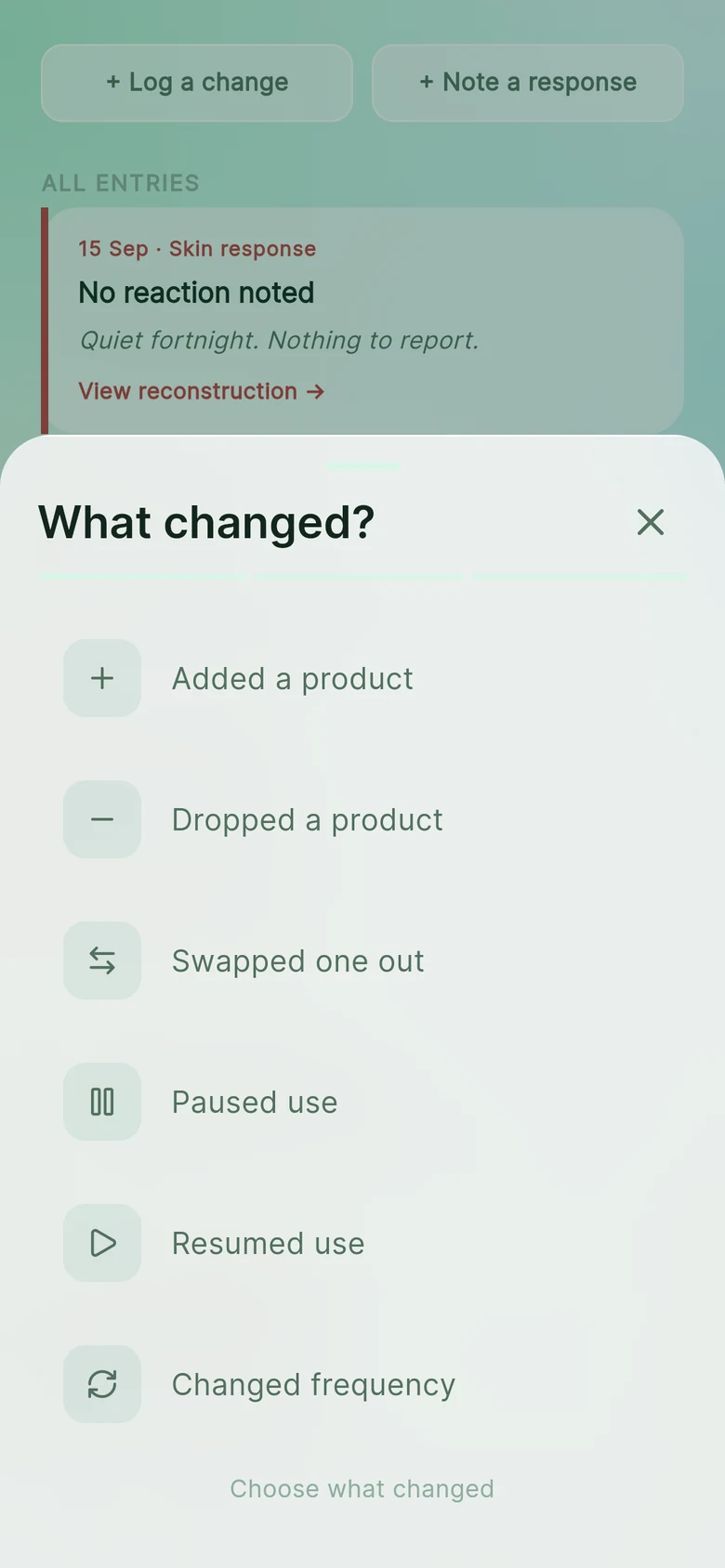
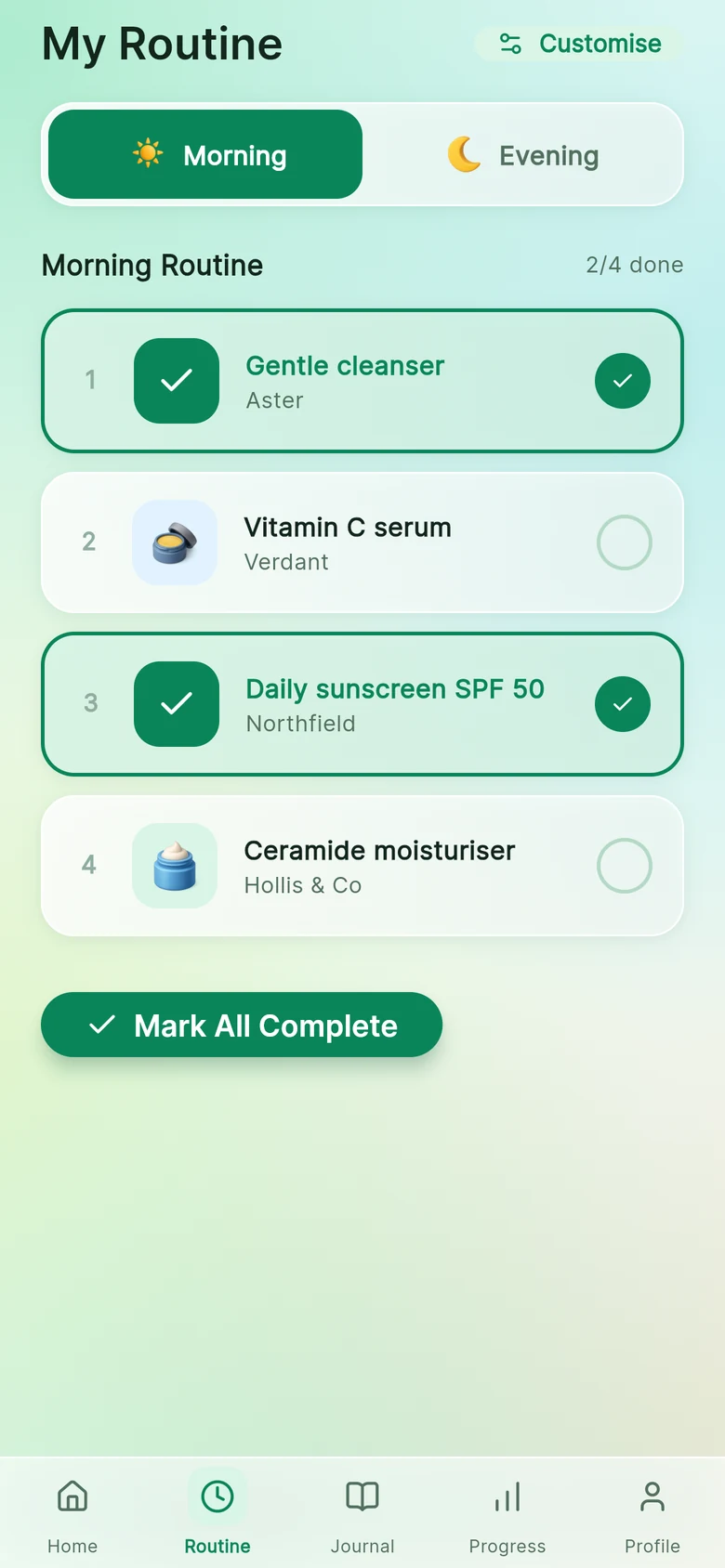
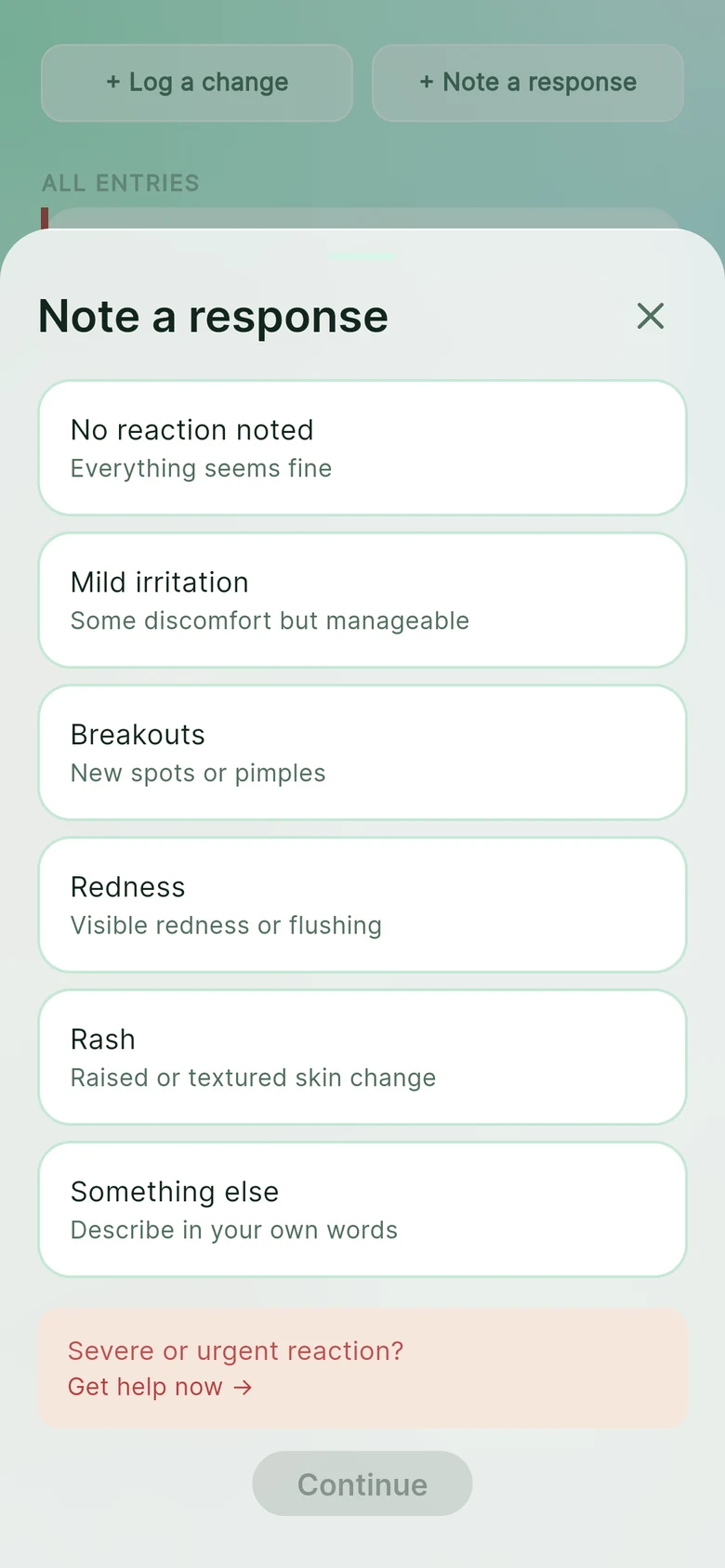
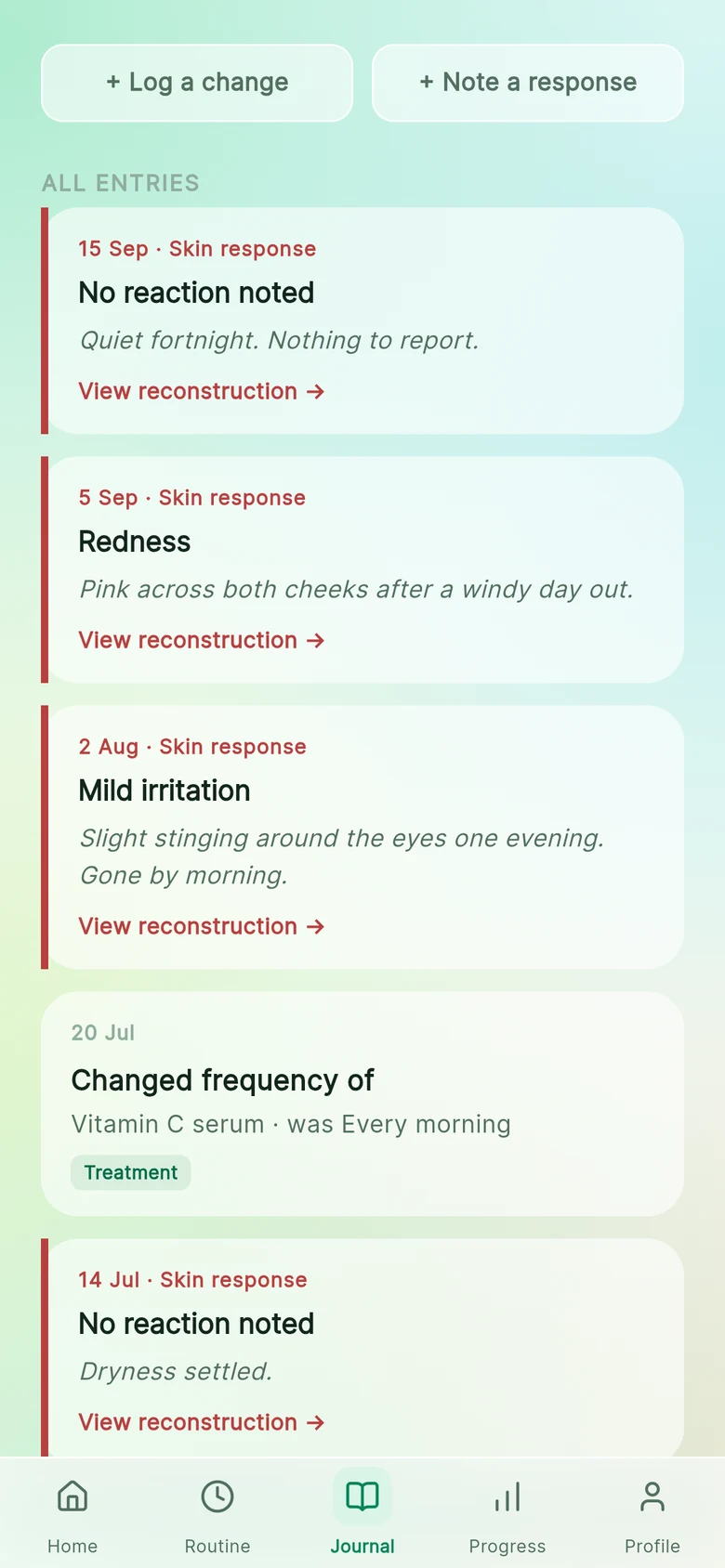
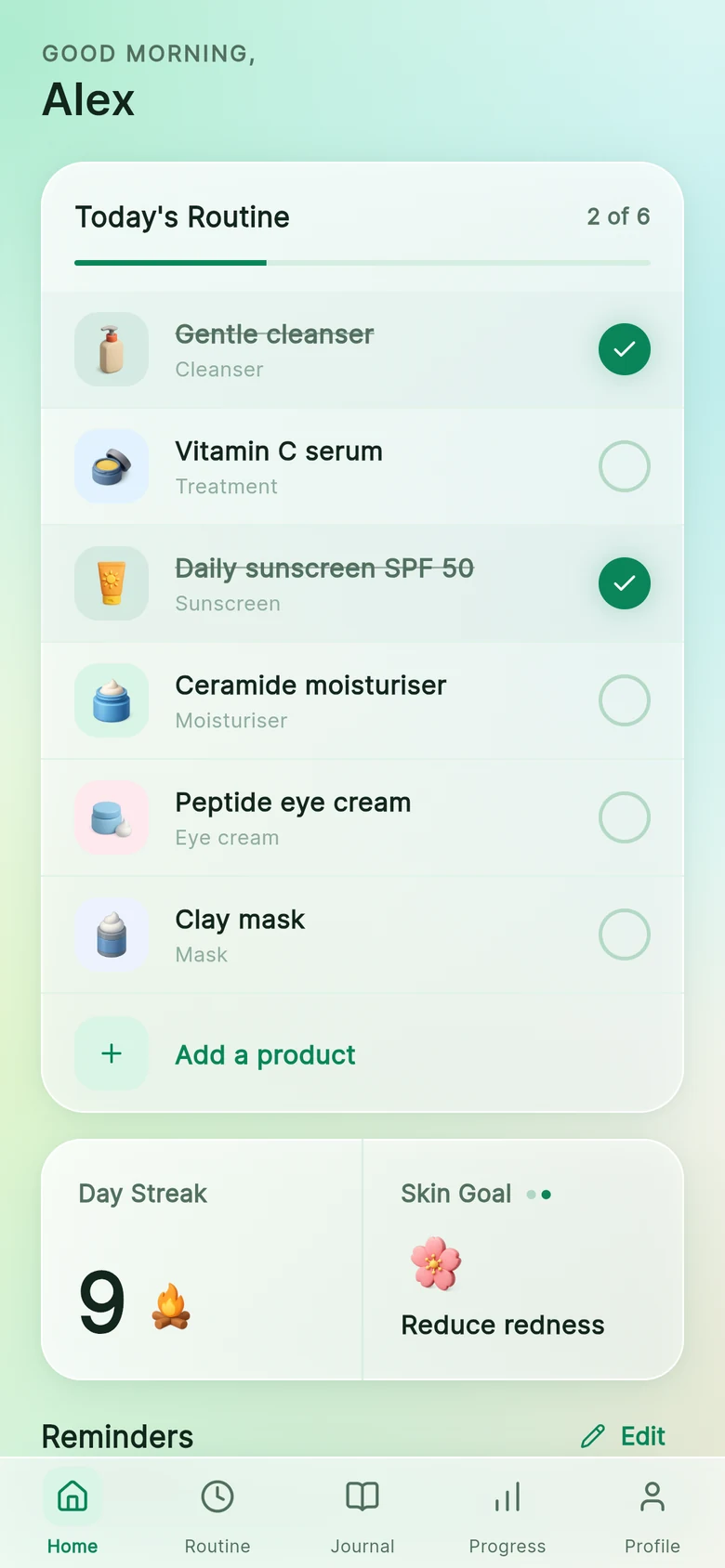
Follows you down the page. Tap the phone to explore. Made-up sample data.
Six weeks, in order.
- Jun
01Wrote down where things stand.Cleanser, moisturiser and serum. Skin feels ordinary. - Jun
02Started a new cleanser.The only change that week. - Jun
09Checked in. Nothing to note.“No reaction” is an entry too. - Jun
16Noticed dryness along the jaw.Two weeks after the cleanser. - Jun
17Also: a hot, dry few days.Written down, not decided about. - Jun
30Paused the toner.One change, on its own. - Jul
14Dryness settled.Kept the cleanser. Toner stays paused. - Jul
15Opened the reconstruction view.The whole sequence, in one place.
One change at a time keeps the record readable.
One change, then wait
- The sequence is short, so it is easy to read back
- You know exactly which day something began
- If nothing happens, that is a clear entry too
- A doctor or pharmacist can follow it in a minute
Three changes in a week
- Everything overlaps, so nothing can be told apart
- Dates blur together within a fortnight
- You end up with a feeling rather than a record
- The reconstruction view will tell you it is harder to read
A timeline isn’t a diagnosis.
Observation is not causation.
If you start a product on Monday and notice redness on Thursday, Skin Memory keeps both facts, with their dates, side by side. It does not say one led to the other.
Many things change at once: the weather, your sleep, stress, a new pillowcase, a trip. The record keeps the sequence, and the sequence is useful. It is just not proof.
You decide what it means. If it matters, so does a doctor or pharmacist, and a clear dated record is a good thing to bring to them.
- Monday Started a new product
- Thursday Noticed redness
- Also that week Travel, dry air, less sleep
Three facts, side by side. Skin Memory keeps all three and does not rank them.
What it does, and what it doesn’t.
Skin Memory does
- Keep your products, changes and notes in order
- Show what was active on any date you choose
- Tell you when changes overlap and are hard to read
- Let you export your record and share it
Skin Memory doesn’t
- Diagnose, treat or assess your skin
- Recommend products or build you a routine
- Score your skin or scan your face
- Tell you what caused a reaction