If you only have 60 seconds
A reconstruction view shows what was logged closest in time to a skin reaction, laid out in the order it happened, instead of asking you to remember it. Most people trying to work out what's behind a breakout or a patch of irritation are relying on memory alone, days after the fact, exactly when memory is least reliable. This piece covers why memory falls short here, what a reconstruction view actually shows, the different shapes a reaction can take, and why it deliberately stops short of naming a single cause.
Memory is a bad record-keeper
Think about the last time your skin reacted to something. Could you say, with confidence, exactly what you'd applied in the three days before it started: the order, the amount, whether you layered anything new on top of something you'd used for months? Most people can name the obvious suspect, usually the newest product, and stop there. But reactions are often the result of a combination, of something used inconsistently, or of a product that had been fine for weeks before it suddenly wasn't.
Memory smooths all of that into a single guess. That's not a failure of attention. It's simply not what memory is built for. Asking someone to accurately recall a sequence of small, routine actions across a two-week span is asking more of memory than it can reliably deliver, no matter how observant they normally are day to day.
A written record doesn't have that problem. If you logged what you used each day, the information about the days before a reaction already exists somewhere. It just needs to be surfaced at the right moment, in the right order, without you having to reconstruct it yourself under pressure, with an already-irritated patch of skin staring back at you and a memory that's already started rewriting the last two weeks into a tidier story than what actually happened.
What the reconstruction view actually shows
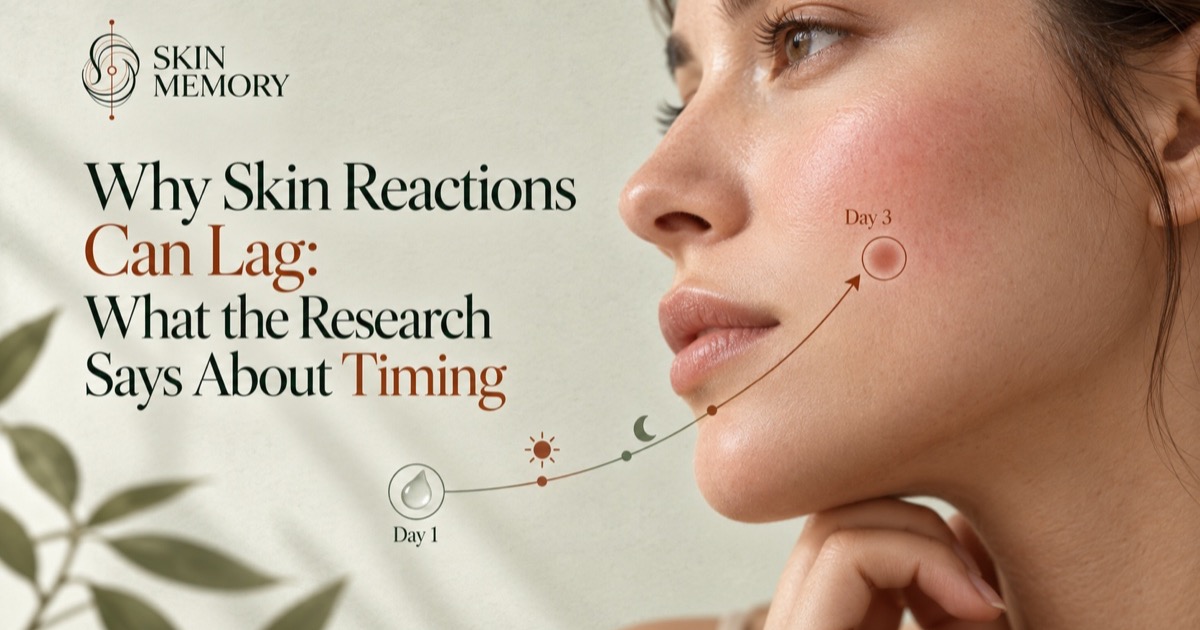
When you log a reaction in Skin Memory, the app pulls up what you recorded closest in time to it: the products, the order you used them in, and how recently each one entered your routine. It's presented as a timeline, not a verdict.
Skin Memory isn't telling you which product is responsible. It's making sure the actual sequence of events is in front of you, clearly, instead of buried across days of entries you'd otherwise have to scroll back through and piece together yourself. That distinction matters more than it might first appear. A tool that told you "this product did this" would be making a claim it has no way to support, given how much it doesn't and can't know about your skin, your history, and everything else happening in your life at the same time: sleep, stress, weather, an unrelated medication.
What a timeline can support, honestly, is showing you what happened and when. The interpretation, especially anything that touches on medical judgment, belongs to you and, ideally, a dermatologist looking at the same timeline with clinical context that neither you nor the app has on its own.
Reactions don't all look the same, which is why a single score can't cover them
Part of why a reconstruction is more useful than a score is that "a reaction" isn't one thing. A few shapes come up often enough to be worth naming, not as a way to self-classify, but as a reminder of why a timeline beats a snapshot:
- Immediate irritation. Stinging or redness within minutes to hours of applying something, often from an active ingredient used at too high a concentration or too frequently. The timeline here is short and usually points to whatever was used that same session.
- Cumulative irritation. A product that was fine in isolation becomes a problem once it's layered daily with something else, or once frequency creeps up over a few weeks. No single entry looks like the culprit; the pattern only shows up across several days of logs.
- Delayed reactions. A true allergic response can take one to several days to surface after exposure, which is exactly the window a same-day photo scan has no way to see.
- Reactions with no clear timeline. Sometimes the log doesn't point anywhere obvious, and that's a legitimate outcome too. A honest reconstruction can show "nothing here stands out" just as easily as it can show a likely candidate, and that's still more useful than a guess dressed up as certainty.
A reconstruction view works across all four shapes the same way: by showing what was logged and when, not by trying to guess which category applies.
Why this beats a trigger-detection algorithm
It would be possible to build a feature that auto-flags a likely trigger by pattern-matching across your logs. Skin Memory deliberately doesn't do this. A system confident enough to name a single product is making a promise it can't reliably keep, given how many variables are actually in play: combinations, dosage, weather, unrelated health changes, even how much sleep you got that week.
A reconstruction view makes a smaller, more honest promise: here is what you logged, in order, around the time this happened. In practice that's usually enough to have a genuinely useful conversation with a dermatologist, who brings the clinical judgment that an auto-flagging feature would otherwise be quietly standing in for without the training to back it up.
What it looks like to use it
In practice, the reconstruction view earns its keep on the days you'd otherwise be guessing. You log a reaction, note what you observed, and the timeline behind it is already there: what changed, what stayed the same, what was new that week. Nothing is ranked, scored, or flagged. It's simply presented in the order it happened, which turns out to be most of what's actually needed.
A typical first step is opening the entry for the reaction itself and scrolling back through the days immediately before it, noting anything that was new, anything used more heavily than usual, and anything applied for the first time in combination with something else. None of that requires the app to draw a conclusion for you. It just requires the record to already exist and be easy to see in order.
The value compounds over time, too. The more consistently entries get logged, even briefly, the more complete the picture is whenever a reaction does show up. It's less about daily discipline and more about having a reliable record waiting for the one day it's actually needed, the day you'd otherwise be trying to remember two weeks of routine from memory alone.
A few habits that make the timeline more useful later
None of these require much effort, but they change how much a reconstruction has to work with later:
- Log changes, not just problems. A routine that's been logged consistently gives a reconstruction far more to show than one that's only updated after something goes wrong.
- Note when something enters or leaves the routine, not just what you're currently using. A product you stopped two weeks ago can still be relevant to a delayed reaction.
- Record amount and frequency, not only the product. "Used nightly" and "used twice this week" produce very different timelines around the same product.
- Write down what you actually observed, in your own words, rather than what you think it means. The observation is durable; a guess about cause ages badly.
If you're weighing whether an app like this is worth using in the first place, why skincare apps shouldn't diagnose you goes into why a scan-and-score approach falls short of what a timeline can do.
FAQ
What is a reconstruction view?
It's a timeline of what you logged closest in time to a skin reaction, shown in order, so you can see the actual sequence of products and events instead of relying on memory.
Does it tell me what caused my reaction?
No. It shows you what happened and when. Working through what's likely relevant, especially anything that needs medical judgment, is something to do with a dermatologist, using that timeline as a starting point.
Do I need to log every day for this to work?
The more consistently you log, the more complete the timeline around any reaction will be, but even partial logging gives you more to work with than memory alone.
Is a reconstruction view the same as an AI diagnosis tool?
No. It doesn't analyze a photo, generate a risk score, or name a cause. It organizes what you already logged into a clear, chronological view.
What if my log doesn't point to anything obvious?
That's a real and useful outcome. A timeline with no standout candidate is still more accurate than forcing a guess, and it's still worth bringing to a dermatologist alongside your symptoms.