If you only have 60 seconds
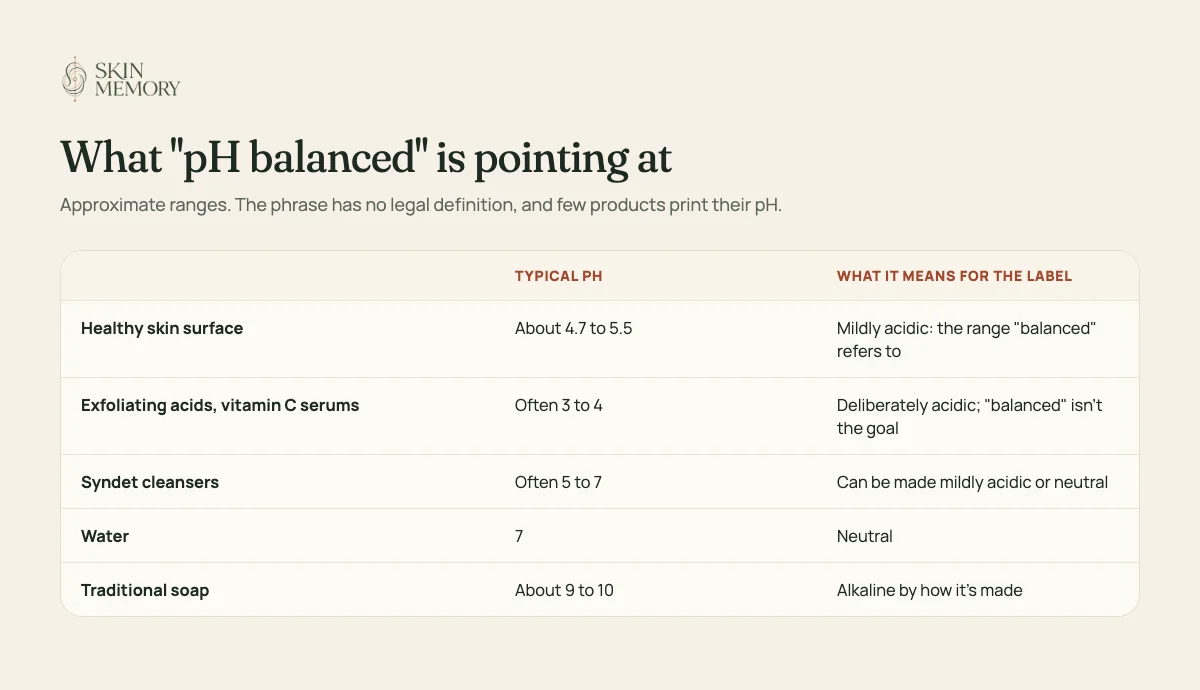
"pH balanced" on a skincare label suggests the product's pH is close to that of healthy skin's surface, which is mildly acidic. A review of the research by Lambers and colleagues estimated the natural skin surface pH at about 4.7 on average, with many sources giving a range of roughly 4.5 to 5.5. Traditional soap, by contrast, is alkaline, usually around pH 9 to 10. The phrase has no legal definition in the US, UK or EU, and most products don't state their actual pH, so "pH balanced" is a description, not a measured promise. It matters most for cleansers. Note the product and how your skin feels after using it.
What pH means, briefly
pH is a scale from 0 to 14 that describes how acidic or alkaline a water-based liquid is. 7 is neutral. Below 7 is acidic; above 7 is alkaline. Each step is a tenfold change, so pH 5 is ten times more acidic than pH 6, and a hundred times more acidic than pH 7.
Only products that contain water have a meaningful pH. An oil, a balm or a powder doesn't, which is why you mostly see "pH balanced" on cleansers, toners and gels.
What pH is your skin?
The surface of the skin is mildly acidic. This thin acidic layer is often called the acid mantle. It is thought to help the skin barrier work properly, support the enzymes involved in renewing the outer layer of skin, and favour the bacteria that normally live there.
Older textbooks often gave skin pH as 5.5. A review in the International Journal of Cosmetic Science by Lambers and colleagues (2006) looked at the measurements more closely. Recent washing and product use push readings up, and once they adjusted for that, they estimated the natural skin surface pH at about 4.7 on average, noting that around half of published measurements were below 5.
Skin pH also varies between body sites, with age, and from person to person, so any single number is an average rather than a target.
Soap vs syndet: where pH matters most
Cleansers are where pH makes the clearest difference, because they are designed to remove oils and sit on wet skin.
- Traditional soap is made by reacting fats with an alkali. True soap is alkaline, typically around pH 9 to 10.
- Syndets ("synthetic detergents") use other cleansing agents and can be made at almost any pH, including mildly acidic. Many facial cleansers and "soap-free" bars are syndets.
A review in Molecules by Mijaljica, Spada and Harrison (2022) summarises the research: soaps tend to raise skin surface pH for a while after washing, remove more of the skin's own lipids, and are more often associated with dryness and tightness than syndets. That doesn't mean everyone reacts badly to soap, and many people use it without trouble. It does mean that the pH of a cleanser is one of the few label details with a clear rationale behind it.
Is "pH balanced" regulated?
No. There is no legal definition of "pH balanced" for cosmetics in the US, UK or EU.
- In the EU and UK, every cosmetic claim must meet the common criteria in Regulation (EU) No 655/2013: truthful, supported by evidence, honest and fair. A brand using the phrase should be able to back it up, but nothing sets which pH counts as "balanced."
- In the US, cosmetic labelling has to be truthful and not misleading, but there is no specific rule for this phrase.
In practice, "pH balanced" can mean the product is close to skin's surface pH, or simply that it isn't strongly alkaline. Very few products print the actual number.
What "pH balanced" can't tell you
- The actual pH. Unless the number is printed, you don't know whether the product is pH 4.5 or pH 7.
- How gentle it is overall. A cleanser's effect on skin depends on its cleansing agents, fragrance, and how long and how often you use it, not just its pH.
- Anything about leave-on actives. Some products are deliberately acidic: exfoliating acids and L-ascorbic acid serums often work at pH 3 to 4. "Balanced" isn't the goal for those, and a low pH is part of how they work. What order to apply skincare covers how layering works when you use more than one of them.
- How your skin will respond. Skin varies. A product that suits most people may not suit you.
If you want to know more about a product than its front label says, reading the ingredient list is the next step. Front-of-pack claims like fragrance-free vs unscented work the same way: useful hints, not definitions.
What to write down
- The product, its type (soap, syndet bar, gel, cream cleanser) and the date you started. A photo of the label and ingredient list covers this.
- Any pH claim, and the number if one is printed.
- How and when you use it. Morning, night, how long it stays on, hot or lukewarm water.
- How your skin feels afterwards, in your own words. "Tight for an hour after washing" or "no change" are both useful.
- Anything else that changed. A new water supply, the season, a new moisturiser. Hard water and winter heating can both affect how skin feels after washing.
If you swap cleansers, treat it as one dated change, and give it a few weeks. Introducing one product at a time keeps it readable.
Where Skin Memory fits
Skin Memory keeps the details a label leaves out. Add your cleanser to your shelf with its role and time of day, and photograph the front and the ingredient list; the app reads the text on your phone, and you check and edit it before saving. Swapping one cleanser for another is logged as a dated change, and anything you notice goes in as an observation in your own words.
Looking back from a date, the reconstruction view shows what was on your shelf and what changed in the 30 days before, without naming a cause. You can download Skin Memory for Android.
More on reading labels: how to read a skincare ingredient list and how long skincare lasts after opening.
If something on your skin concerns you, talk to a doctor or pharmacist, and bring the dated record with you.
FAQ
What does pH balanced mean on skincare?
It suggests the product's pH is close to that of skin's surface, which is mildly acidic. The phrase has no legal definition, and most products don't print their actual pH, so it is a description rather than a measured promise.
What is the pH of healthy skin?
Mildly acidic. A 2006 review estimated the natural skin surface pH at about 4.7 on average, and many sources give a range of roughly 4.5 to 5.5. It varies by body site, age and person.
Is soap bad for your skin because of its pH?
Traditional soap is alkaline, usually around pH 9 to 10. Research suggests soaps raise skin surface pH for a while after washing and remove more of the skin's own lipids than syndet cleansers, and they are more often linked with dryness. Many people use soap without problems.
What is a syndet?
A syndet, short for synthetic detergent, is a cleanser made with cleansing agents other than soap. Syndets can be formulated at a mildly acidic or neutral pH. Many facial cleansers and "soap-free" bars are syndets.
Is pH balanced regulated?
No. There is no legal definition in the US, UK or EU. In the EU and UK, a brand must be able to support any claim it makes, but nothing defines which pH counts as balanced.
Should every skincare product be pH balanced?
Not necessarily. Some products, like exfoliating acids and L-ascorbic acid serums, are deliberately acidic because that is how they work. pH matters most for cleansers.
Is this medical advice?
No. It is general information. If something concerns you, talk to a doctor or pharmacist.