
If you only have 60 seconds
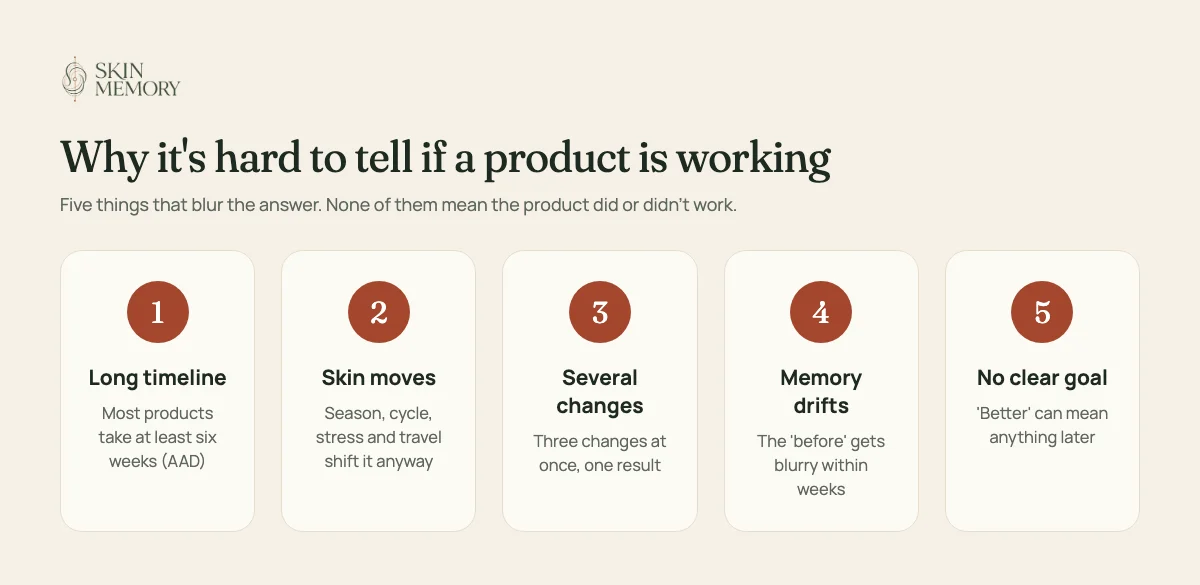
It is hard to tell if a skincare product is working because the effect, if there is one, is slow and small, while everything around it keeps moving. The American Academy of Dermatology says most products take at least six weeks to work and some take up to three months, and acne routines take several weeks to a few months. In that time your skin also changes with the season, your cycle, stress and the rest of your routine, and memory is a poor record of where you started. A fairer answer comes from three things: one change at a time, enough weeks, and a dated note of what your skin was like before you began.
Reason 1: the timeline is longer than it feels
The AAD's advice on getting results from skincare products is blunt: a moisturiser may plump fine lines within days, but "most products take at least six weeks to work," and some take three months. For acne, the AAD's skin care tips say it may take several weeks to a few months to see a difference.
Most people decide much sooner. A bottle that runs out in four weeks often gets judged at four weeks. We covered typical timelines by product type in how long skincare takes to work; the short version is that the judgement usually arrives before the evidence does.
Reason 2: skin changes on its own
Skin is not a still background. Over any six-week stretch it can shift with:
- Season and indoor heating. Colder, drier air changes how skin feels, which we covered in why your skin changes in winter.
- Hormonal cycles. Many people notice differences across the month; see does your menstrual cycle affect your skin.
- Travel, water and sleep. A trip, a new city or a week of short nights all overlap with whatever you are testing.
There is also a pattern statisticians call regression to the mean. People tend to start a new product when their skin is at a low point. Skin that is having an unusually bad week will often drift back toward its usual state anyway, which can make whatever you started that week look effective. The reverse happens too: a product started on a good week can look like it made things worse.
Reason 3: you rarely change just one thing
A new serum often arrives with a new cleanser, a new season and a new sleep schedule. When three things change at once, any difference afterwards belongs to all of them together, and no amount of looking at your skin can separate them. The AAD's advice for people trying new products is to start with one product at a time, partly because several new products at once can irritate skin and partly because it keeps the result readable.
Reason 4: memory rewrites the starting point
Ask yourself what your skin was like six weeks ago, in detail. Most people can't say. Memory blends weeks together, and it is shaped by what you are feeling now and what you hoped would happen. If you paid for a product and wanted it to work, the "before" tends to look worse in hindsight.
This is the same problem described in memory is the weakest record of your skincare routine: without something written at the time, the comparison is between a vague memory and a vivid present.
Reason 5: "working" was never defined
"Is it working?" only has an answer if you know what you were looking for. Less shine by midday? Fewer dry patches on the cheeks? Makeup sitting better? A product can do one thing and not another. If the goal was never written down, it is easy for it to shift over the weeks, and then any result can be read as success or failure.
A fairer way to tell if your skincare is working
You can't remove all the noise, but you can make the question answerable.
- Write a short baseline before you start. What you use now, how often, and how your skin looks and feels in a few plain words. Two or three photos in the same light help if you take them.
- Name the one thing you are watching. "Dry patches on the cheeks" is better than "better skin."
- Change one thing. Keep everything else as steady as you reasonably can for the trial period. Introducing one product at a time covers how.
- Pick a review date up front. Six weeks is a reasonable default for most products, based on the AAD's guidance. Put it in your calendar.
- Note anything else that changes. A trip, a new medication, the heating going on. You can't control these, but you can record them.
- Compare notes, not memories. On the review date, read your baseline before you look in the mirror.
Even then, the answer is often "maybe" or "I can't tell." That is an honest result, and it is useful: it tells you this product is not obviously better than what you had, which is worth knowing before you buy it again.
What to write down
- The product and the date you started it
- Your one-line goal for it
- A two-line baseline: routine and how your skin is
- The review date
- Anything else that changed during the trial, dated
- On the review date: what you see now, in the same words you used for the baseline
What this can't tell you
A careful home trial can tell you whether you noticed a difference. It can't tell you why, and it can't diagnose anything. If your skin is getting worse, sore, or you are worried about a change, don't wait out a six-week trial. Talk to a pharmacist, doctor or dermatologist.
Where Skin Memory fits
Skin Memory is built for exactly this kind of record, without judging it. Every product on your shelf carries the date you started, paused or dropped it, and each change goes into the timeline. A baseline is simply your dated shelf and a short note before you change something; the app has no separate baseline screen and doesn't need one.
When you look back from a date, the reconstruction view shows what was on your shelf and what changed in the 30 days before, and it says when three or more changes overlap, which is a signal the result will be hard to read. It never tells you whether a product worked. That part is yours. You can download Skin Memory for Android.
More on keeping a record: what to look for in a skincare tracker app and how to keep a skincare journal.
If something on your skin concerns you, talk to a doctor or pharmacist, and bring the dated record with you.
FAQ
How do you know if your skincare is working?
Compare your skin now with a written note of how it was before you started, after enough time, with only one thing changed. Without a baseline and a single change, any difference is hard to attribute to the product.
How long should you try a skincare product before deciding?
The American Academy of Dermatology says most products take at least six weeks to work and some take up to three months. Acne routines can take several weeks to a few months. Deciding sooner usually means judging before the evidence is in.
Why does my skincare seem to stop working?
Several things can be happening: the season or your routine may have changed, you may be remembering the early weeks more kindly than they were, or your skin may simply be having a different few weeks. A dated record makes it easier to see what else changed.
Can I test two new products at once?
You can, but if your skin changes you won't be able to tell which one was involved, and using several new products at once can irritate skin. Starting one at a time, a few weeks apart, keeps the result readable.
What is regression to the mean in skincare?
People often start a new product when their skin is at its worst. Skin tends to drift back toward its usual state anyway, which can make whatever was started at that time look effective even if it made no difference.
Should I take photos to track skincare results?
Photos can help if they are taken in the same light, place and angle each time. A short written note alongside them is still useful, because photos don't capture how skin feels.
Is this medical advice?
No. It is general information. If something concerns you, talk to a doctor or pharmacist.