If you only have 60 seconds
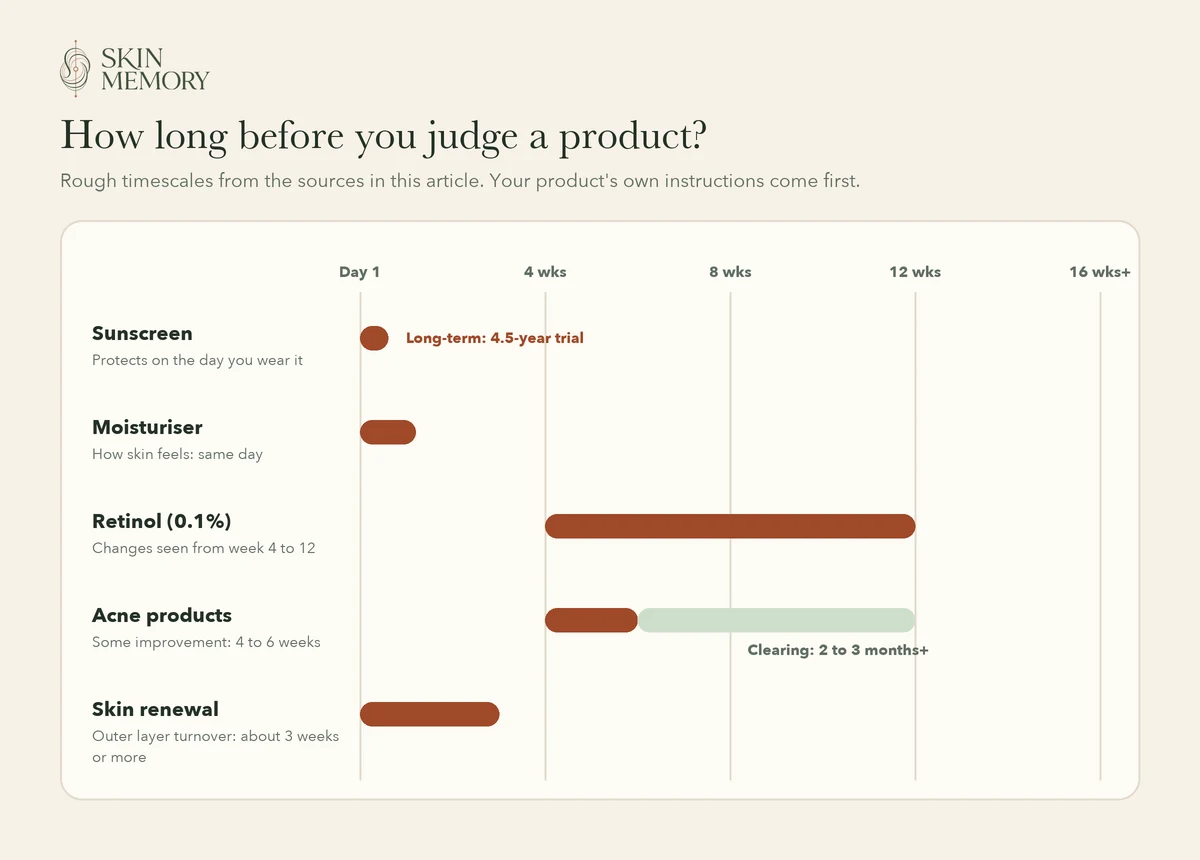
There is no single answer, because different products are judged on different timescales. Sunscreen protects on the day you wear it, while the longest trial of its effect on skin ageing ran for 4.5 years. In one analysis of six studies of 0.1% retinol, changes were recorded from week 4 and through week 12. The American Academy of Dermatology says acne products may show some improvement in 4 to 6 weeks, with clearing taking two to three months or longer. The practical lesson is the same for all of them: decide how long a fair trial is before you start, write down the start date, and change one thing at a time.
Why there is no single answer
"Does it work?" hides three different questions:
- How does it feel? A moisturiser changes how skin feels within minutes. That is a real effect, but it is not the same as a change that builds over months.
- Is it doing its everyday job? Sunscreen's job is protection on the day you wear it. You cannot see that job being done, which is why people sometimes decide it "isn't working".
- Is something changing over time? Retinoids, acne products and long-term sun protection are judged over weeks, months or years.
Judging a slow product on a fast timescale is the most common way to give up on something too early, or to blame the wrong thing.
What the research and guidance say, product by product
| Product type | What sources say | Timescale |
|---|---|---|
| Sunscreen | Protection on the day; a 4.5-year trial measured long-term skin ageing | Same day, and years |
| Moisturiser | Changes how skin feels soon after applying | Same day |
| Retinol (0.1%) | Pooled studies recorded changes from week 4 through week 12 | 4 to 12 weeks |
| Acne products | Some improvement in 4 to 6 weeks; clearing in two to three months or longer | 1 to 3 months+ |
| Skin renewal | The outer layer took about 20 days to turn over in young adults in one classic study | About 3 weeks or more |
Sunscreen: the day you wear it, and the years after
Sunscreen's protective job happens on the day. Its longer-term effect is the slowest thing on this list to measure. In a randomised trial published in Annals of Internal Medicine in 2013, Hughes and colleagues followed 903 adults under 55 in Nambour, Australia, for 4.5 years. The group asked to use sunscreen daily showed no detectable increase in skin ageing over that time, as measured by impressions of the backs of their hands, and ageing was 24 percent less than in the group that used sunscreen at their own discretion.
That is four and a half years of daily use. Nobody can judge it from a single summer.
Retinol: weeks, not days
A 2024 integrated analysis in the Journal of Drugs in Dermatology by Farris and colleagues pooled six vehicle-controlled studies of 0.1% retinol in women with mild to moderate signs of photoageing. Compared with the vehicle, the retinol groups showed greater improvement from as early as week 4, continuing through week 12. Irritation was uncommon in those studies, and was mild to moderate and temporary when it happened.
Two things are worth knowing when you read that. The analysis was funded by the company that makes the product, and several authors worked for it. And the participants were a narrow group: women aged 30 and over with lighter skin types. It is a useful marker for how long a trial is, not a promise about any particular product.
Acne products: 4 to 6 weeks for a first look
The American Academy of Dermatology's guidance on acne that won't clear says that if a treatment works for you, you should see some improvement in 4 to 6 weeks, and that it can take two to three months or longer to see clearing. It advises giving an acne treatment at least 4 weeks, and warns that using a new acne product every few days can worsen acne and irritate skin.
If a product was prescribed, the timeline your prescriber gave you comes first.
Skin renewal: the slow background clock
Under all of these sits the pace at which skin renews itself. The outer layer took about 20 days to turn over in young adults in one classic study, and longer in older adults. Why skin reactions can lag covers that research, and why it means the most recent change is not always the relevant one.
Why switching too soon makes everything harder to read
Every switch resets the clock. If you swap a serum after ten days, then a moisturiser a week later, then a cleanser, nothing on your shelf has had a fair trial, and if your skin does change, you have several overlapping candidates and no clean window to look at.
There is also the adjustment period some ingredients come with. The AAD's guidance on testing skincare products notes that ingredients such as retinol and glycolic acid can cause temporary irritation, particularly on sensitive skin. A rough first week might be that, or it might not. Neither this article nor a record can decide which, but a record shows the dates and what you noticed, so the conversation with a pharmacist or doctor starts from facts. How to introduce a new skincare product covers patch testing and that first stretch in more detail.
How to give a product a fair trial

- Write down a baseline first. A few days of how your skin usually is. Without a "before", a slow change is invisible. The baselines page shows what that looks like.
- Patch test, then log the start date. The actual date, on the day.
- Choose your review date before you start. Four weeks, six weeks, twelve: whatever the product's instructions or your prescriber suggest. Deciding in advance stops one bad day from becoming the verdict.
- Hold everything else steady. One change at a time keeps the window readable.
- Note what you notice, in your own words, when you notice it. Not a score. A sentence.
- Take photos in the same light at the start and at the review date, if that is something you want to compare.
- Review on the date you chose, then log the decision. Keep, pause or drop, with the date. That ending is part of the record too.
If something concerns you before the review date, you do not have to wait for it. Stop and talk to a pharmacist or doctor.
Where Skin Memory fits
Skin Memory is built for this kind of slow reading. Adding a product to your shelf records the date it started. The change log records pauses, swaps, stops and changes in how often you use something, so "I've been using it about a month" becomes an actual date. The daily journal lets you note how your skin feels in your own words, and experiments show how a single change looks when it is recorded from start to review.
Over months, that becomes a skin history you can scroll back through, which is how skincare should be read: over weeks, not judged day by day. It does not tell you whether a product worked. It keeps the dates, so you can see what happened and when. You can download Skin Memory for Android.
If something on your skin concerns you, talk to a doctor or pharmacist, and bring the dated record with you.
FAQ
How long does skincare take to work?
It depends on the product and what you are judging. Moisturiser changes how skin feels the same day. Sunscreen protects on the day you wear it. Studies of retinol recorded changes from week 4 through week 12, and the AAD says acne products may show some improvement in 4 to 6 weeks.
How long does retinol take to work?
In a 2024 analysis of six studies of 0.1% retinol, improvements compared with a vehicle were recorded from week 4 and continued through week 12. The analysis was industry-funded and studied a narrow group of participants.
How long should I use an acne product before switching?
The American Academy of Dermatology says to expect some improvement in 4 to 6 weeks and clearing in two to three months or longer, and to give a treatment at least 4 weeks, warning that switching products every few days can worsen acne. If you are unsure, ask a pharmacist or dermatologist.
Can I tell if sunscreen is working?
Not by looking on a given day. Its job is protection while you wear it. The longest trial of its effect on skin ageing followed people for 4.5 years.
Why does my skin look worse when I start a new product?
Some ingredients, such as retinol and glycolic acid, can cause temporary irritation, especially on sensitive skin. A record of dates and observations helps, but it cannot tell you which situation you are in. If something concerns you, talk to a pharmacist or doctor.
Is this medical advice?
No. It is general information. If something concerns you, talk to a doctor or pharmacist.