If you only have 60 seconds
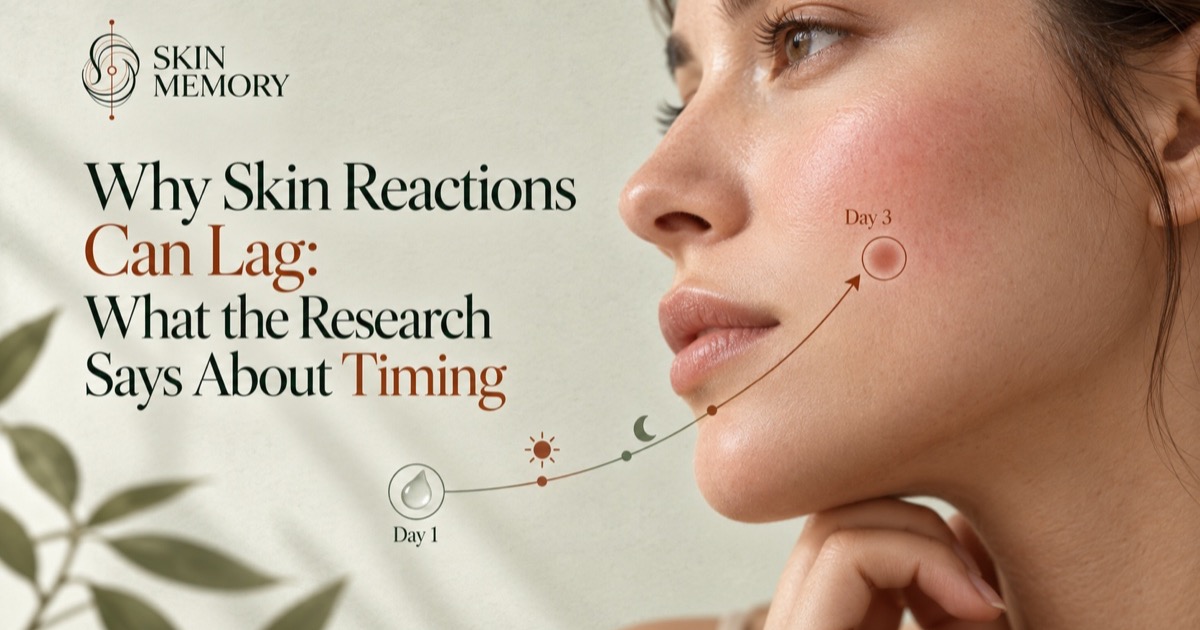
When you add several skincare products at once and your skin changes, you are left with several suspects and no way to tell them apart. Introducing one product at a time keeps the sequence readable. Patch-test research adds a second lesson about patience: in one study of 328 repeated application tests, the median reaction appeared on day 3, but 8.5 percent of positive results appeared after day 7. This piece covers what that research says, what it cannot tell you, and a simple way to try something new without losing track.
Why one change at a time
Most people use more products than they think. In a 2025 Rutgers Health study published in the Journal of Exposure Science & Environmental Epidemiology, 593 participants reported using an average of 14.5 personal care products a day, across nearly 9,350 specific products. Skincare is only part of that, but it shows how crowded a normal morning already is.
Now picture a new cleanser, a new serum and a new moisturiser starting on the same Monday. If something shows up on your skin on Thursday, all three started on the same day, so the timeline cannot separate them. Stopping all three and starting again one by one costs more time than introducing them one at a time would have.
One change at a time does not tell you what caused anything. What it does is keep the record legible. When only one thing changed in a window, the question "what was different?" has a short answer.
What a patch test is, and where it comes from
A patch test in the everyday skincare sense means trying a product on a small area before using it more widely. The American Academy of Dermatology's public guidance describes applying the product to a quarter-sized spot, such as the underside of the arm or the bend of the elbow, twice a day for seven to 10 days, using the amount you would normally use. For something you would usually rinse off, like a cleanser, it suggests leaving it on for about five minutes, or as long as the instructions say.
That home version is a simplified cousin of a clinical method called the repeated open application test, or ROAT. It was described in a 1986 paper in Contact Dermatitis by Hannuksela and Salo, who had 86 patients with contact dermatitis apply test substances to the inner forearm, near the elbow crease, twice daily for seven days, unless a reaction appeared sooner.
What the research says about how long to test
The research question is simple: how many days does a repeated test need before a reaction would have shown up?
A 2022 study in Contact Dermatitis by the French Dermatology and Allergology group (Amsler and colleagues) collected 328 ROAT results for topical products. Among the positive results, the median time to a reaction was 3 days, 91.5 percent had appeared by day 7, and all had appeared by day 10. The authors concluded that a minimum of 10 days is necessary and probably sufficient, and noted that the European Society of Contact Dermatitis recommends 15 days. They also noted something every skincare user will recognise: people rarely keep a test going beyond a week.
Put plainly, a test that stops at day 5 or 7 would have missed some of the reactions this study recorded. That is one reason the AAD's seven to 10 days is a range, and a reason not to cut it short.
What a patch test cannot tell you
- A forearm is not a face. The test area is a stand-in. A clear result makes a reaction less likely to be missed, not impossible.
- Clinical tests and home tests differ. The studies above tested people who were already being investigated for contact dermatitis, with measured amounts under supervision. A home test is looser.
- A reaction does not name an ingredient. It tells you something happened with that product on that skin. Identifying a specific allergen is what formal patch testing by a clinician is for.
- Some changes build slowly. Irritation can develop gradually with repeated use, which is why the first weeks of full use are still worth recording, as why skin reactions can lag explains.
Some ingredients come with an adjustment period
The same AAD guidance notes that some ingredients, such as retinol and glycolic acid, can irritate skin, particularly sensitive skin, and describes that as normal and temporary. That creates a real problem for anyone judging a product in its first week: an early rough patch might be an adjustment period, or it might not.
A record cannot decide which one you are having, and neither can this article. What a record can do is show you the dates, what you noticed and how it changed, so that you, or a pharmacist or doctor you talk to, are working from facts rather than a blur. If a product was prescribed, follow the instructions of the person who prescribed it.
How long to wait before the next change
There is no single correct number, and anyone giving you one with confidence is overselling. The research points to several timescales that overlap:
- Days: delayed allergic reactions are classically described as appearing 24 to 72 hours after contact.
- Weeks of repeated use: irritation can build gradually rather than appear on day one.
- Around three weeks or more: the outer layer of skin took about 20 days to turn over in young adults in one classic study, and longer in older adults.
A common general observation period is around two weeks. Treat that as a starting point you can adjust, not a clinical rule, and it helps to read your skin over weeks rather than day by day.
A one-change routine, step by step
- Note a baseline first. For a few days before the new product, jot down how your skin feels. Without a "before", there is nothing to compare an "after" to.
- Patch test the new product. Seven to 10 days on a small area, per the AAD guidance above.
- Log the start date on the day you start. Not "last week". The actual date.
- Hold everything else steady. Same cleanser, same moisturiser, same sunscreen. If something else has to change, for example a product runs out and the replacement is a different formula, log that as its own change.
- Write down what you notice, when you notice it. In plain words, without deciding what it means.
- Pick a review date before you start. Deciding in advance stops a single bad day from becoming the verdict.
- Log the ending too. Whether you keep the product, pause it or drop it, the date it happened is part of the record.
Changes that are easy to miss
- The same product in a new formula, a new strength, or from a different brand after a restock
- Using a product more often, or less often, than before
- A product moved from evenings to mornings
- Returning to a product after a break, which is a change, not a continuation
- Something applied "just once" from a friend's shelf or a hotel bathroom
Where Skin Memory fits
Skin Memory is built around this way of working. Your shelf holds what you use. The change log records when you add, pause, resume, drop or swap a product, defaults to today, and lets you backdate an entry when you forgot, marking it as recorded after the change. The daily journal lets you note how your skin feels in your own words, and Note a response lets you record an observation without the app interpreting it. The experiments page shows how a single change looks when it is recorded this way.
If something does change on your skin, the reconstruction view shows what was logged in the 30 days before, in order, without ranking anything or naming a cause. A one-change routine is what makes that view short and easy to read.
If something on your skin concerns you, talk to a doctor or pharmacist, and bring the dated record with you.
FAQ
How long should I patch test a new skincare product?
The American Academy of Dermatology's public guidance describes twice a day for seven to 10 days on a small area. In a 2022 study of 328 repeated application tests, all positive results appeared within 10 days, though most appeared much sooner.
Where should I patch test?
The AAD guidance suggests a quarter-sized spot on the underside of the arm or the bend of the elbow. The clinical version of the test uses the inner forearm near the elbow crease.
If a patch test is clear, does that mean the product is safe for my face?
No. A clear result on your arm makes a reaction less likely to be missed, but it is not a guarantee for facial skin, and some irritation only builds with repeated use.
Can I introduce two products at once if one is a rinse-off cleanser?
You can, but if your skin changes you will not be able to tell the two apart from the timeline. Introducing one at a time keeps the record readable.
How long should I wait between new products?
There is no single right answer. A common general observation period is around two weeks, which you can adjust. It is a general default, not clinical guidance.
Is this medical advice?
No. It is general information. If something concerns you, talk to a doctor or pharmacist.