
If you only have 60 seconds
A skincare journal (or skin diary) is a dated record of what you put on your skin, what you changed, and what you noticed. It is only as good as its timing: in a well-known diary study, people's paper diaries looked 90 percent complete, but sensors in the binders showed that only 11 percent of entries were actually made on time. Write each entry on the day it happens, keep it to six simple fields, and record changes as changes. This guide covers what to write down, when, and what a journal can and cannot tell you.
What is a skincare journal?
A skincare journal is a running, dated log of your routine and your skin. It answers three plain questions for any day you look back at: what was I using, what had changed recently, and what did I notice?
It is not a mood board, a product review or a list of goals. Those can be useful, but they answer different questions. The value of a journal is the dates. Without them, you are left with the version of events your memory hands you, which, as why memory is the weakest record of your skincare routine covers, tends to be tidier than what actually happened.
Why the timing of an entry matters more than its length
The most cited evidence on diary accuracy comes from outside skincare. In a 2002 report in the BMJ and the fuller 2003 study in Controlled Clinical Trials, Stone, Shiffman and colleagues gave adults with chronic pain a paper diary to fill in three times a day for three weeks. The paper binders had hidden light sensors that recorded when they were opened.
The diaries handed back looked about 90 percent complete. The sensors showed that actual on-time completion was about 11 percent. On roughly a third of study days the binder was never opened, yet entries for those days were filled in anyway, presumably from memory, afterwards. A comparison group using a time-stamped electronic diary completed about 94 percent of entries on time. (The authors had links to the company that made the electronic diary, which is worth knowing when you read the comparison.)
The lesson for a skincare journal is not "paper bad, app good". It is that an entry written later is a memory, not a record, even when it looks exactly like one. A short note made today beats a detailed note reconstructed on Sunday.
What to write down: the six fields that matter
You do not need a template with twenty boxes. These six fields cover nearly everything you will want later.
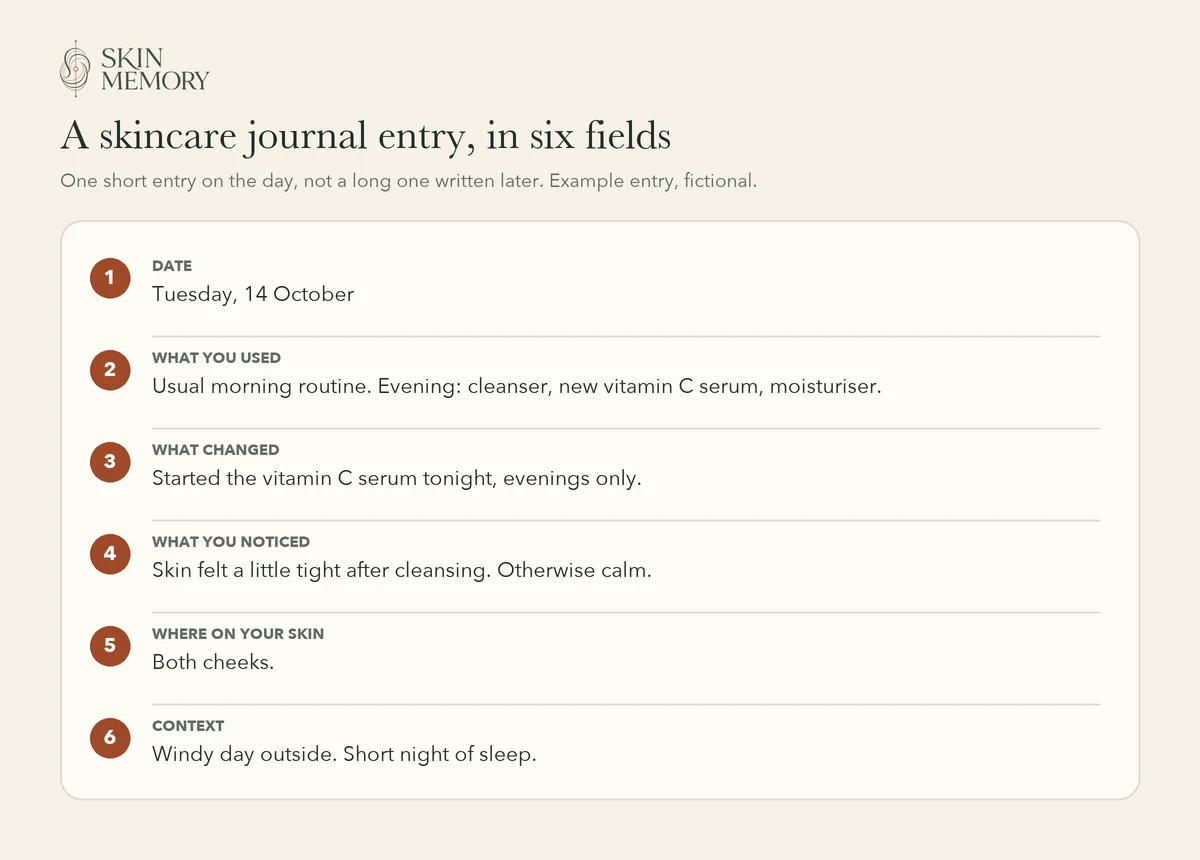
- Date. The actual date, every time. "Last week" is not a date.
- What you used. Product name, and morning or evening. On days nothing changed, "usual routine" is a complete entry.
- What changed. A new product, a stopped product, a swap, a new strength, or using something more or less often. Changes are the entries you will search for most, so give them their own line.
- What you noticed, in your own words. "Tight across the cheeks after cleansing" is more useful later than a score out of ten. Describe; do not diagnose.
- Where on your skin. Forehead, jawline, around the eyes, hands. Location is easy to forget and hard to reconstruct.
- Context, briefly. Travel, a new climate, poor sleep, a new medication, a change in cycle, a different laundry detergent. You are not deciding whether any of it matters, only that it happened.
Optional, but useful
- A baseline. A few entries before a change, describing your skin as it usually is. Without a "before", an "after" has nothing to be compared with. The baselines page shows how this looks in practice.
- Photos in the same light. Same window, same time of day, same angle. How to describe a skin reaction to a doctor or pharmacist has a short checklist for photos that hold up.
- When you opened a product. Useful for knowing how long it has been in use, and for the period-after-opening symbol on the label, which how long skincare lasts after opening explains.
When to write: a simple rhythm
- Every day, briefly. One line is enough. Consistency matters more than detail.
- On the day of any change. Log a new product on the day you start it, not when you remember to.
- When you notice something. Write it down when you see it, with the date and location, before you start forming theories.
- Once a week, read back. Not to judge, just to see the sequence. Skin is easier to read over weeks than day by day, which skincare should be understood over time goes into.
If you miss a day, leave the gap or mark the entry as written later. A gap is honest. A back-filled entry that looks like it was made at the time is the exact problem the diary study above measured.
What a skincare journal can and cannot tell you
It can show you the order things happened in, what changed in the weeks before you noticed something, and how long you have used a product. It can make a conversation with a pharmacist or doctor faster and more concrete, because you bring dates rather than impressions.
It cannot tell you what caused a change on your skin. Two things happening close together is a sequence, not an explanation. Reactions can also appear days or weeks after a change, as why skin reactions can lag covers, so the most recent change is not automatically the relevant one. A journal narrows the list of things to talk about. It does not pick one.
This is why introducing one new product at a time and keeping a journal work well together: when only one thing changed in a window, the record stays short and readable.
Paper, notes app or a skincare tracker app?
Any of them can work. What matters is that the method makes on-time entries easy and back-filled entries visible.
| Method | Good at | Watch out for |
|---|---|---|
| Paper notebook | Fast, private, no setup | No timestamps; easy to back-fill; hard to search |
| Notes app | Always with you; searchable | Free text drifts; changes get buried in daily notes |
| Spreadsheet | Structured; easy to sort by date | Tedious on a phone; easy to abandon |
| Skincare tracker app | Dates and changes captured by default | Choose one that records rather than scores or diagnoses |
Some condition-specific organisations offer their own trackers. The National Eczema Association, for example, publishes a free app, EczemaWise, for logging eczema symptoms and possible triggers. If you are tracking a diagnosed condition, ask your clinician which format they find most useful.
Where Skin Memory fits
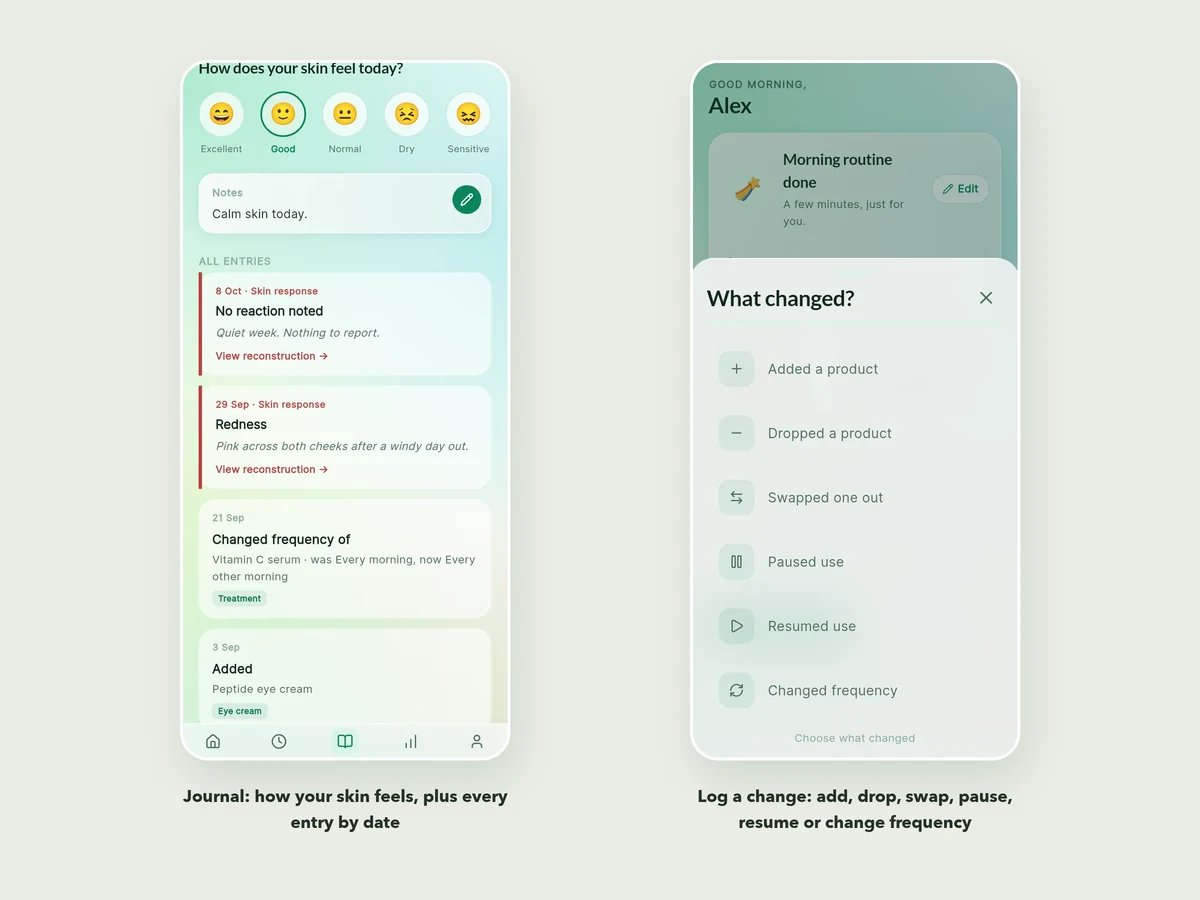
Skin Memory is a skincare journal app built around dates and changes. Your shelf holds what you use. The change log records adds, pauses, swaps and stops, defaults to today, and lets you backdate an entry when you forgot, marking it as recorded after the change, so a late entry never passes for an on-time one. The daily journal asks how your skin feels in your own words, and Note a response lets you record an observation with its date without the app interpreting it. Details like where on your skin go in the note, in your own words.
Over months, that becomes a skin history you can scroll, export or delete. If something changes, the reconstruction view lays out what was logged in the 30 days before, in order, without ranking anything or naming a cause. You can download Skin Memory for Android.
If something on your skin concerns you, talk to a doctor or pharmacist, and bring the dated record with you.
FAQ
What should I write in a skincare journal?
The date, what you used, what changed, what you noticed in your own words, where on your skin, and brief context such as travel or a new medication. Changes are the most important entries, so give them their own line.
How often should I update a skincare journal?
Briefly every day, and always on the day of a change or when you notice something. A one-line entry made on time is more reliable than a detailed entry written days later.
Is a skin diary the same as a skincare journal?
Yes. Skin diary, skincare journal, skincare log and skincare tracker all describe a dated record of your routine and your skin.
Can a skincare journal tell me which product caused a reaction?
No. A journal shows the order things happened in. It does not establish cause, and reactions can appear days or weeks after a change. It can make a conversation with a doctor or pharmacist more specific.
Is a paper skincare journal good enough?
It can be, if you write on the day and mark anything written later. Research on paper diaries found that many entries were filled in afterwards while looking as if they were made on time, so the habit matters more than the format.
Is this medical advice?
No. It is general information. If something concerns you, talk to a doctor or pharmacist.