If you only have 60 seconds
It is common to use two products with the same active ingredient without noticing: a salicylic acid cleanser and a salicylic acid spot treatment, a glycolic acid toner and a glycolic acid serum, or a retinol serum and a retinol eye cream. The actives add up, so your skin gets more than either product was designed to deliver on its own. That isn't automatically a problem, but it is a common reason for dryness and irritation, and the American Academy of Dermatology advises starting one product at a time and following directions because overuse can cause dryness and other problems. Check the ingredient lists side by side, note which products share an active, and ask a pharmacist if you are unsure.
What counts as an "active ingredient"
In everyday skincare talk, an "active" is any ingredient included to do something specific to the skin, as opposed to a base ingredient like water or glycerin. Common ones include:
- Exfoliating acids: glycolic, lactic and mandelic acid (AHAs); salicylic acid (a BHA); gluconolactone (a PHA)
- Retinoids: retinol, retinal (retinaldehyde), retinyl esters, and prescription retinoids like adapalene or tretinoin
- Benzoyl peroxide
- Vitamin C: ascorbic acid and its derivatives
- Niacinamide, azelaic acid
- Sunscreen filters
In the US, a few of these are regulated as over-the-counter drugs when sold to treat acne. The FDA's acne drug monograph lists benzoyl peroxide at 2.5 to 10% and salicylic acid at 0.5 to 2% as permitted strengths, with label directions written for one product. Those directions don't account for a second product with the same ingredient.
Why using the same active twice matters
Each product is formulated and tested on its own, at its own strength and frequency. Use two with the same active and you are running a combination nobody designed:
- The total amount goes up. A 2% salicylic acid cleanser followed by a 2% salicylic acid toner exposes your skin to more of it each day than either label suggests.
- The frequency goes up. An exfoliating toner used every morning plus an exfoliating serum used every night is twice-daily exfoliation, even if each label says "daily."
- Irritation can build slowly. Dryness, tightness or flaking from too much of one active often appears over days or weeks, not on first use, which makes the doubled-up product easy to miss.
The AAD's guidance on getting results from skincare notes that using more than directed can cause clogged pores, blotchy skin or excessive dryness, and that several new products at once can irritate skin. Its acne tips add that trying new acne treatments too often can irritate skin.
None of this means two products with the same active can never be used together. Dermatologists sometimes combine products on purpose. The point is to know it is happening, so it is a decision and not an accident.
Common overlaps to look for
| Pair | Shared active | Where it hides |
|---|---|---|
| Acne cleanser + spot treatment | Salicylic acid or benzoyl peroxide | Cleansers are easy to forget because they rinse off |
| Exfoliating toner + "glow" serum | Glycolic or lactic acid | Serums marketed for brightness or texture |
| Retinol serum + eye cream or night cream | Retinol or retinyl esters | Often listed as "retinyl palmitate" further down the list |
| Body wash + face products | Salicylic or glycolic acid | Body products used on the chest, back or neck |
| Moisturiser + serum + toner | Niacinamide | Increasingly included in many products at once |
| Moisturiser with SPF + sunscreen + foundation with SPF | Sunscreen filters | Sun protection values don't simply add together |
How to check your routine for doubled-up actives
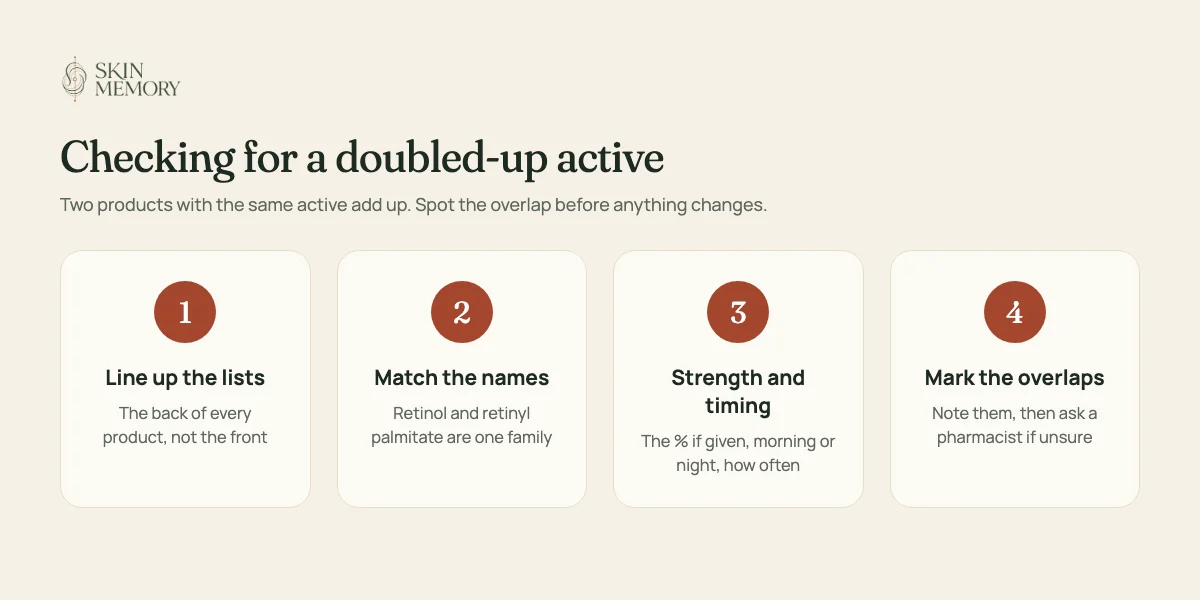
- Gather every product you use on your face, including cleansers, toners, masks, eye creams and anything used "sometimes."
- Read the ingredient list on each. The front of the pack often highlights one active and leaves out others. How to read a skincare ingredient list explains the order and naming.
- Search for the same active under different names. Retinol might appear as retinyl palmitate or retinyl acetate. Vitamin C might be ascorbic acid, sodium ascorbyl phosphate or ascorbyl glucoside. Salicylic acid is sometimes listed as "BHA" on the front and "salicylic acid" on the back.
- Note the strength where it is given. Many products state a percentage on the front. If not, position on the list is a rough hint only.
- Note when you use each one. Morning, night, every day, twice a week. Two products used on different days overlap less than two used in the same routine.
- Mark the overlaps. You don't have to change anything yet. Just knowing which products share an active is useful if your skin changes later.
If you are already using a prescription product, such as a prescription retinoid or benzoyl peroxide gel, check any over-the-counter product with a pharmacist before adding something with the same or a similar active.
What to write down
- Each product's main active ingredients, copied from the back of the pack (a photo is fine)
- The strength, if stated
- When you use it: morning, night, how many times a week
- Which products share an active
- The date you started each one, and the date you change how often you use it
- Anything you notice in the weeks after, in your own words
If you decide to drop one of the overlapping products, treat that as a dated change of its own. Introducing or removing one product at a time keeps the following weeks easy to read, and the order of steps in what order to apply skincare matters too.
What this can't tell you
A side-by-side list can show you that two products share an active. It can't tell you whether that combination is right for your skin, or whether it is involved in anything you are seeing. Those are questions for a pharmacist, doctor or dermatologist, who can take your skin, medications and history into account. If your skin becomes painful, swollen or blistered, stop and get medical advice.
Where Skin Memory fits
When you add products to your shelf, you give each one a role, such as cleanser, exfoliant or treatment, and a time of day. If you add a second active product with the same role, the app mentions it, in case that is not what you meant, and you can carry on regardless. It goes by the role you choose, not by reading ingredients, so it won't flag a retinol eye cream and a retinol serum filed under different roles.
Ingredients are optional: you can photograph the ingredient list and the app reads it on your phone, or look a product up by name in Open Beauty Facts, and you check and edit the result before saving. That puts the lists side by side in one place when you want to compare them. You can download Skin Memory for Android.
More on trying things carefully: how to introduce one new product at a time and what is skin cycling.
If something on your skin concerns you, talk to a doctor or pharmacist, and bring the dated record with you.
FAQ
Can you use two products with the same active ingredient?
Sometimes, and dermatologists occasionally combine products on purpose. But using two products with the same active increases the total amount your skin gets, which is a common reason for dryness and irritation. Check with a pharmacist if you are unsure, especially if one product is prescribed.
Can I use a salicylic acid cleanser and a salicylic acid toner?
Many people do, but it means more salicylic acid each day than either product's directions assume. If you notice dryness, tightness or flaking, the overlap is one of the things worth noting and mentioning to a pharmacist.
How do I know if two products have the same active ingredient?
Read the ingredient list on the back of each product, not just the front. Look for the same ingredient under different names, such as retinol and retinyl palmitate, or ascorbic acid and sodium ascorbyl phosphate.
Does layering two sunscreens give you a higher SPF?
Not in a simple way. SPF values don't add together, and the protection you get depends mostly on applying enough of one product. See how much sunscreen to use on your face for the amounts involved.
Is it bad to use too many actives?
Using many actives at once makes irritation more likely and makes it hard to tell what any one product is doing. The American Academy of Dermatology advises starting one product at a time and following directions.
Should I stop one of the products?
That depends on your skin and your goals, and it is a good question for a pharmacist or dermatologist. If you do drop one, note the date so you can see what happens after.
Is this medical advice?
No. It is general information. If something concerns you, talk to a doctor or pharmacist.