
If you only have 60 seconds
Skin cycling is an evening routine that rotates over four nights: one night with a chemical exfoliant, one night with a retinoid, then two "recovery" nights with only gentle, moisturising products, before the cycle starts again. The term was coined and popularised by New York dermatologist Dr Whitney Bowe. The ideas behind it, spacing out strong products and giving skin time between them, have support. The exact four-night sequence has not been tested against other schedules in published studies, so it is best treated as a sensible template, not a proven protocol. Because it changes what you use on which night, it is also a routine worth writing down.
What is skin cycling?
Skin cycling is a way of scheduling the stronger products in an evening routine so they don't all land on the same night. Instead of using an exfoliant and a retinoid every night, or layering them together, you give each one its own night and follow them with nights off.
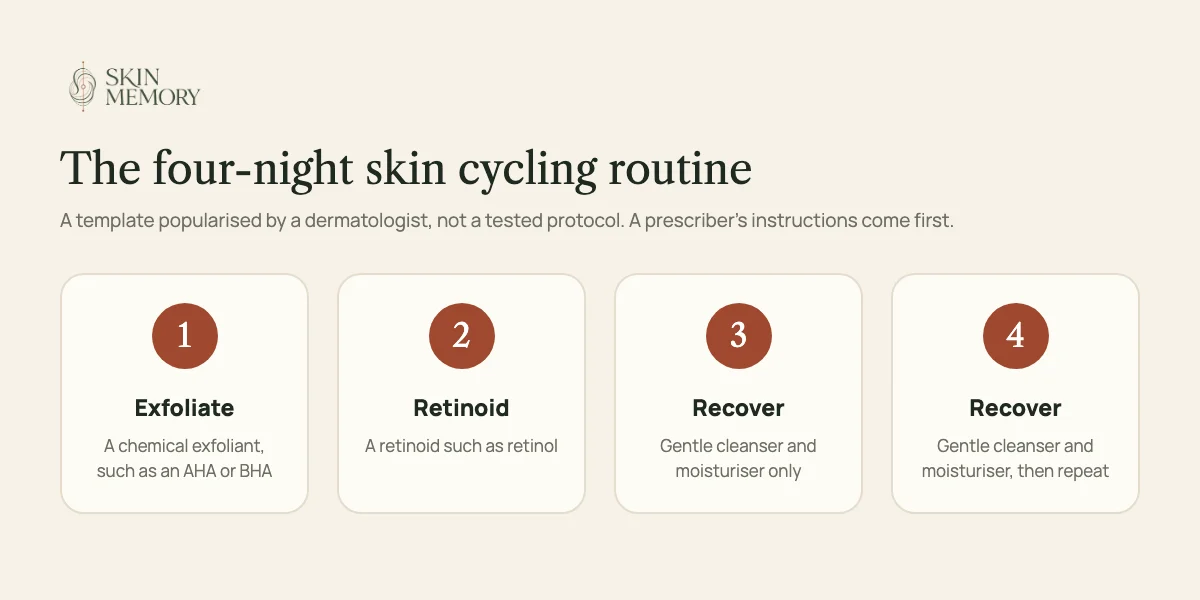
A 2026 Dermatology Times explainer describes the standard cycle like this:
- Night 1, exfoliation: a chemical exfoliant, such as an AHA (for example glycolic or lactic acid) or a BHA (salicylic acid).
- Night 2, retinoid: a retinoid such as retinol.
- Nights 3 and 4, recovery: only hydrating and barrier-supporting products, such as a gentle cleanser and a moisturiser, with no exfoliants or retinoids.
Then the cycle repeats. Morning routines usually stay the same, which for most people means cleansing, moisturising and sunscreen.
Where skin cycling came from
The term was popularised on social media from 2022 by Dr Whitney Bowe, a board-certified dermatologist in New York. The idea she described is that many people can't tolerate a retinoid every night, and that combining strong products on the same night makes irritation more likely. Spreading them out and building in recovery nights is a way to use both with fewer bad nights.
Does skin cycling work? What the evidence says
The Dermatology Times piece makes a useful distinction:
- The principles have support. Using a retinoid intermittently rather than every night can improve how well people tolerate it, and limiting how often chemical exfoliants are used is standard advice.
- The specific schedule has not been tested. No published study has compared the four-night sequence against other schedules. The article describes it as a heuristic, a rule of thumb, rather than a validated protocol.
That is a reasonable way to see it. Skin cycling is not a treatment, and it is not magic. It is a structured way of doing what many dermatologists already suggest: introduce strong products slowly and don't stack them.
Who might need a different schedule
The same article notes that the template is meant to be adjusted:
- People with rosacea or eczema may need a more individual approach, and possibly more than two recovery nights.
- Prescription retinoids, such as tretinoin, behave differently from over-the-counter retinol and often need more recovery time. If a prescriber has given you instructions, follow those, not a social media template.
- People who tolerate retinoids well may find the standard cycle uses them less often than they need.
- Strong acids and retinoids should not be layered on the same night without time in between.
If you are not sure whether skin cycling suits your skin, ask a pharmacist, doctor or dermatologist. It is their call to make with you, not a template's.
Starting skin cycling without losing track
Skin cycling is several changes at once, wearing one name. Starting it might mean a new exfoliant, a new retinoid, a new evening order, and fewer nights with products you used to use every day. If your skin changes in the first few weeks, all of those are candidates.
Some ways to keep it readable:
- Patch test any product that is new to you before it joins the cycle. How to patch test skincare covers the seven-to-ten-day method dermatologists suggest.
- Add one new product at a time. If both the exfoliant and the retinoid are new, start one, wait, then add the other. One change at a time explains why.
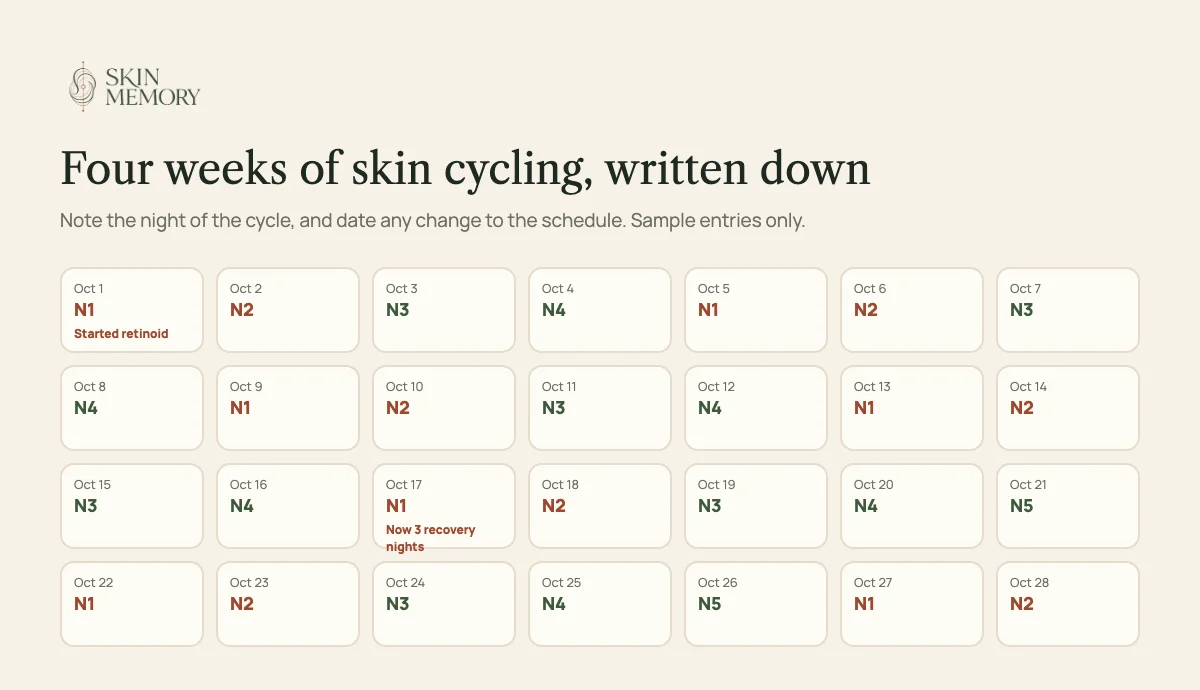
- Write down the night of the cycle in a short note: "N1 exfoliant", "N3 recovery". After a few weeks it is easy to lose count.
- Note when you change the schedule, for example dropping to one recovery night or adding a third. A change in how often you use a product is a change.
- Give it time before deciding. How long skincare takes to work covers why a few weeks is usually too early to judge.
The order you apply products in still applies within each night: cleanse, then any treatment step, then moisturiser.
Where Skin Memory fits
Skin Memory keeps a dated record of the routine, without scoring it or telling you whether it is working. Your shelf records when each exfoliant and retinoid started, and the change log records swaps, pauses and changes in how often you use something. The daily journal is a natural place for "night 2, retinoid" notes, and Note a response records an observation like dryness or flaking in your own words.
Over months, your skin timeline shows the cycle as it really happened, not as it was planned, which is the slow reading skincare should be understood over time argues for. You can download Skin Memory for Android.
If something on your skin concerns you, talk to a doctor or pharmacist, and bring the dated record with you.
FAQ
What is skin cycling?
Skin cycling is a four-night evening routine: one night with a chemical exfoliant, one night with a retinoid, then two recovery nights with only gentle, moisturising products, before repeating. It was popularised by dermatologist Dr Whitney Bowe.
What is the skin cycling schedule?
Night 1 exfoliation (an AHA or BHA), night 2 a retinoid, nights 3 and 4 recovery with a gentle cleanser and moisturiser only, then repeat. Mornings usually stay the same, including sunscreen.
Does skin cycling work?
The principles behind it, using retinoids intermittently and limiting exfoliants, have support. The specific four-night sequence has not been tested against other schedules in published studies, so it is best seen as a sensible template rather than a proven protocol.
Can beginners do skin cycling?
Many people use it as a gentle way to start using a retinoid or exfoliant. Introduce one new product at a time, patch test it first, and ask a pharmacist or dermatologist if you are unsure whether it suits your skin.
Is skin cycling suitable for sensitive skin, rosacea or eczema?
It may need adjusting. Dermatologists note that people with rosacea or eczema may need a more individual approach and possibly more recovery nights. Ask a dermatologist before starting strong products.
Can I do skin cycling with prescription tretinoin?
Follow your prescriber's instructions. Prescription retinoids behave differently from over-the-counter retinol and often need a different schedule.
Is this medical advice?
No. It is general information. If something concerns you, talk to a doctor or pharmacist.