
If you only have 60 seconds
The American Academy of Dermatology says the sequence in which you apply skincare affects how well the products work, and suggests a simple order: wash your face with a gentle cleanser, apply any medication or treatment right after cleansing, then moisturiser and/or sunscreen, then makeup if you wear it. Apply sunscreen to dry skin about 15 minutes before going outdoors, and reapply about every two hours while you are outside. Beyond that, the most useful rule is to keep the order steady, because moving a product from morning to night, or putting it on before something it used to follow, is a change to your routine like any other.
The basic order dermatologists suggest
The AAD's guidance on whether to apply skincare in a certain order is short:
- Wash your face with a gentle cleanser, and gently pat dry.
- Apply medication or treatment. If you use a medicine or other treatment on your skin, apply it right after cleansing.
- Apply moisturiser and/or sunscreen.
- Apply makeup, if you wear it.
The same page adds two practical notes: use your ring finger for creams around the eyes, because it pulls least on that thin skin, and be aware that using too many products may irritate the skin, especially more than one anti-ageing product at a time.
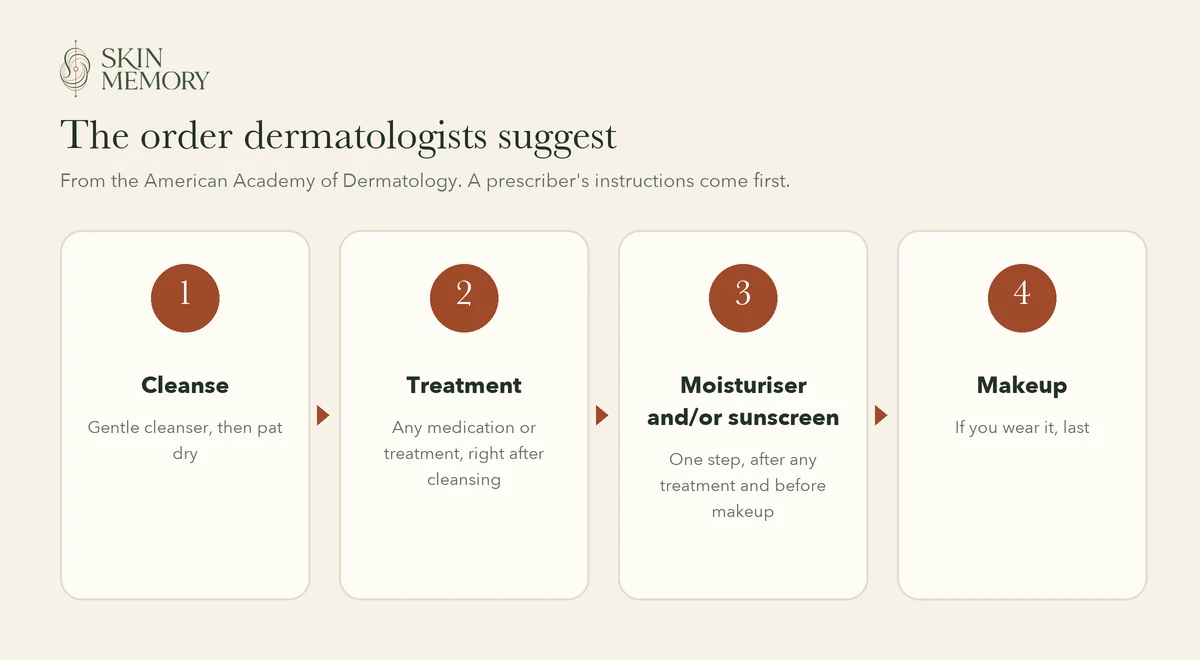
If a doctor or pharmacist has given you instructions for a prescribed product, including when to apply it and what to put on top, those come first.
Where common products fit
Most routines are a version of those four steps. Here is how common products usually map onto them:
| Product | Usual place in the order |
|---|---|
| Cleanser | First, morning and night |
| Prescribed or medicated treatment | Right after cleansing, unless your prescriber says otherwise |
| Serum (e.g. vitamin C, niacinamide) | Usually after cleansing, before moisturiser |
| Eye cream | With the treatment or moisturiser step; apply with the ring finger |
| Moisturiser | After treatments and serums |
| Sunscreen | Morning, in the moisturiser and/or sunscreen step, before makeup |
| Makeup | Last |
A common rule of thumb for anything not on the list is "thinnest to thickest": watery products before richer creams. It is a widely used guideline rather than one the AAD spells out, and a product's own directions take priority.
Morning and night are different routines
- Morning: cleanse, any treatment, moisturiser, sunscreen, makeup. Sunscreen is the step the day depends on. The AAD's sunscreen guidance advises applying it to dry skin 15 minutes before going outdoors and reapplying about every two hours outdoors, or after swimming or sweating, according to the label.
- Night: cleanse (removing makeup and sunscreen), any treatment, moisturiser. No sunscreen.
Some products are labelled for night use only, and some prescribed treatments come with timing instructions. Follow the label or the prescriber.
Fewer steps make the order easier to keep
The AAD's warning about using too many products is worth taking seriously for another reason too. Every extra step is another thing that can move, double up or be skipped, and another candidate if your skin changes. A four-step routine you repeat the same way every day is easier to keep, and far easier to read back, than a ten-step routine that varies.
If you are adding something, introduce one new product at a time, and decide in advance how long you will give it, since different products work on different timescales.
Changing the order is a change
This is the part routines rarely account for. People record a new product, but not that they moved their serum to the evening, started layering two products in one step, or dropped the toner. Each of those changes what your skin is exposed to, and when.
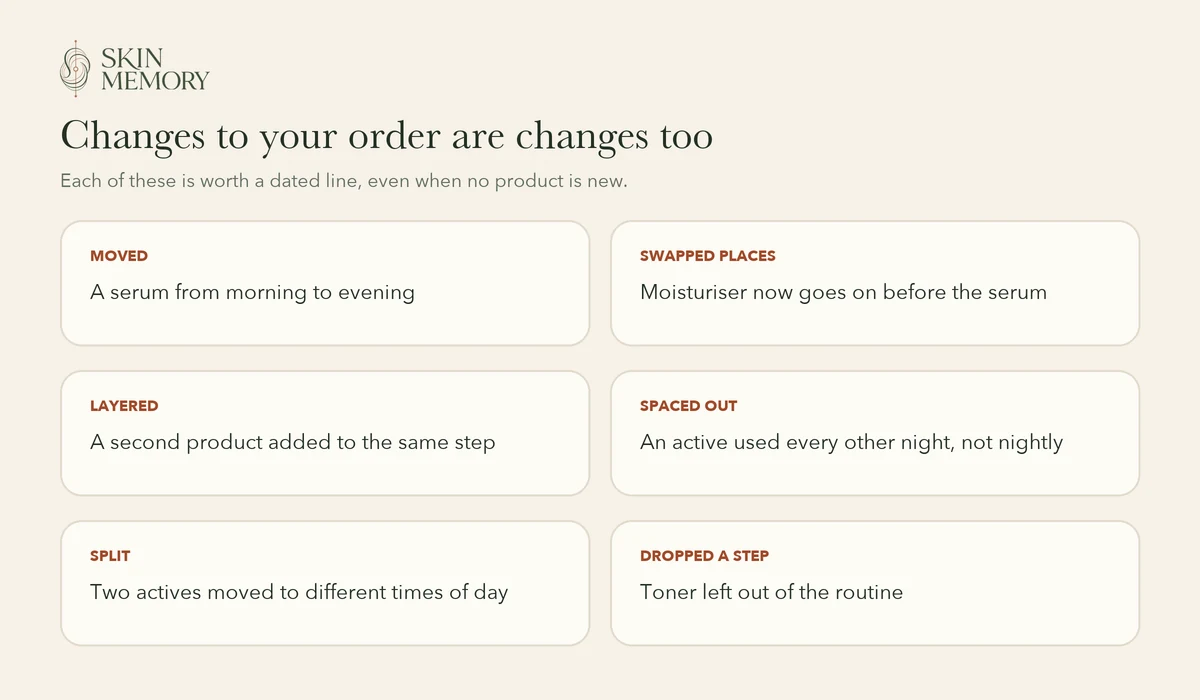
Worth a dated line, even when no product is new:
- A product moved between morning and night
- Two products swapped places in the order
- A second product layered into the same step
- An active product spaced out, for example every other night instead of nightly
- Two actives split between morning and night
- A step dropped
These changes are easy to forget within a week, and memory is the weakest record of what you actually did. If your skin changes a month later, "I think I moved the serum around then" is much less useful than a date.
Where Skin Memory fits
Skin Memory keeps your morning and evening routines separately, and records changes to them with the date: products added, dropped, swapped, paused or resumed, and changes in how often you use something. The daily journal lets you note how your skin feels, and your skin timeline shows every change in the order it happened.
If something on your skin changes, the reconstruction view lays out what was logged in the 30 days before, in order, without ranking anything or naming a cause. Pair that with a photo of each product's ingredient list and a simple skincare journal habit, and you have the record a pharmacist or doctor will want. You can download Skin Memory for Android.
If something on your skin concerns you, talk to a doctor or pharmacist, and bring the dated record with you.
FAQ
What order should I apply skincare products?
The American Academy of Dermatology suggests: wash with a gentle cleanser, apply any medication or treatment, apply moisturiser and/or sunscreen, then makeup if you wear it. A prescriber's instructions for a specific product come first.
Does sunscreen go before or after moisturiser?
The AAD groups them as one step, moisturiser and/or sunscreen, after any treatment and before makeup. It advises applying sunscreen to dry skin 15 minutes before going outdoors, and following the product's directions.
Where does serum go in a skincare routine?
Usually after cleansing and before moisturiser. A common rule of thumb is thinnest to thickest, but a product's own directions take priority.
Is the night routine different from the morning routine?
Usually, yes. At night you cleanse to remove makeup and sunscreen, apply any treatment, then moisturiser, with no sunscreen. Some products are labelled for night use only.
How many skincare products should I use?
There is no set number. The AAD notes that using too many products may irritate the skin, especially more than one anti-ageing product at a time. Fewer steps are also easier to keep consistent and to keep track of.
Is this medical advice?
No. It is general information. If something concerns you, talk to a doctor or pharmacist.