If you only have 60 seconds
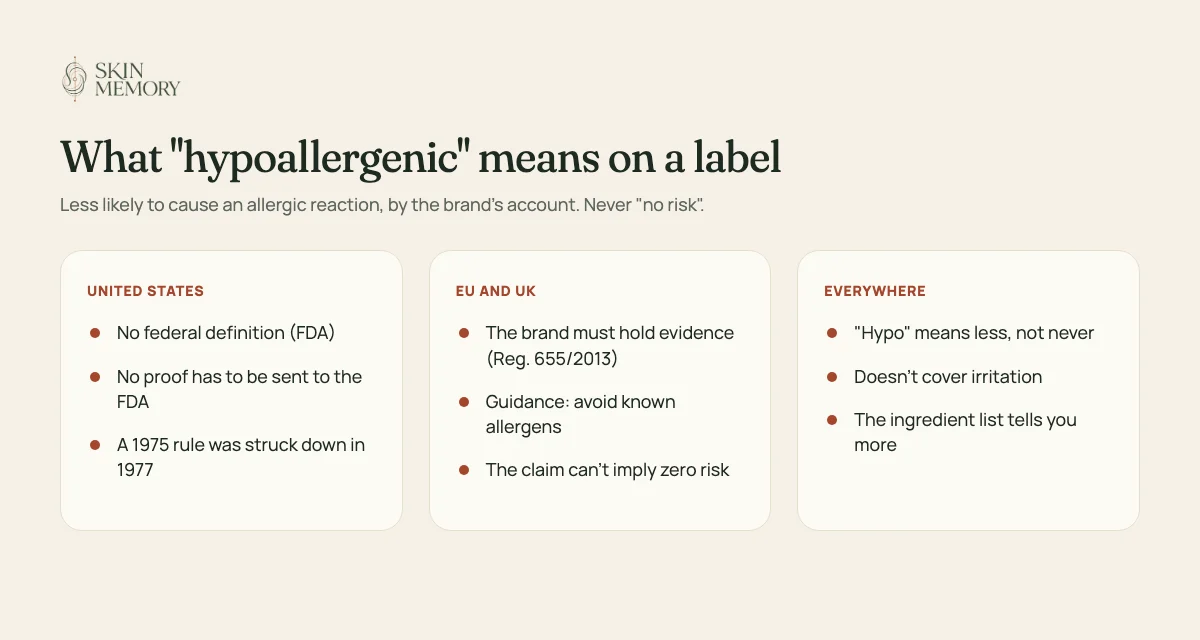
"Hypoallergenic" on a skincare label means the brand says the product is less likely to cause allergic reactions than other products. In the United States there is no legal definition: the FDA says there are no federal standards for the term, it "means whatever a particular company wants it to mean," and brands don't have to prove the claim to the FDA. In the EU, a brand must hold evidence for the claim, and guidance says the product should avoid known allergens, but the word can never mean zero risk. You can still react to a hypoallergenic product. A patch test and a dated note are more useful than the label.
What "hypoallergenic" is meant to say
The prefix "hypo" means "less" or "under." So "hypoallergenic" means less allergenic, not non-allergenic. Even taken at its best, the word describes a lower chance of an allergic reaction, not an absence of one.
An allergic reaction to a skincare product, called allergic contact dermatitis, happens when the immune system becomes sensitised to a specific ingredient. It is different from irritation, where an ingredient directly irritates the skin without an allergy being involved. Most reactions to skincare are irritation, not allergy, and "hypoallergenic" doesn't address irritation at all.
Is "hypoallergenic" regulated?
In the United States: no definition
The FDA's page on hypoallergenic cosmetics is unusually direct. It says:
- There are no federal standards or definitions that govern the use of the term "hypoallergenic."
- The term "means whatever a particular company wants it to mean."
- Manufacturers are not required to submit substantiation of their hypoallergenic claims to the FDA.
The FDA did try to define it. In 1975 it issued a regulation requiring comparative testing before a product could be labelled hypoallergenic. Two cosmetics companies challenged it, and in 1977 a federal appeals court struck the rule down, finding the FDA had not shown consumers understood the word the way the regulation defined it. No replacement definition has been issued since.
In the EU and UK: evidence required, no guarantee
In the EU, every cosmetic claim must meet the common criteria in Regulation (EU) No 655/2013: legal compliance, truthfulness, evidential support, honesty, fairness and informed decision-making. A brand using "hypoallergenic" has to hold evidence for it.
A 2017 technical document on cosmetic claims, endorsed by the EU's Working Group on Cosmetic Products, adds guidance specifically for "hypoallergenic": the product should be designed to minimise its allergenic potential, known allergens and allergen precursors should be avoided, and the claim must not suggest there is no risk at all. The document is guidance rather than law, but national regulators use it. The UK retained the same claims criteria after leaving the EU.
Why you can still react to a hypoallergenic product
Even a carefully made hypoallergenic product can be followed by a reaction, for several reasons:
- Allergies are individual. A product can avoid the most common allergens and still contain something you personally are sensitised to.
- Irritation isn't covered. Exfoliating acids, retinoids, alcohol or a very low pH can irritate skin whatever the allergy profile.
- Sensitisation can take time. An allergy can develop to an ingredient you have used before without trouble.
- The rest of your routine is still there. The hypoallergenic product sits alongside everything else you use, and a reaction after starting it does not mean it was involved. Why skin reactions can lag covers why timing is hard to read.
Hypoallergenic vs fragrance-free vs "for sensitive skin"
| Label | What it suggests | Defined in law? |
|---|---|---|
| Hypoallergenic | Less likely to cause allergic reactions | No (US). EU: evidence required, guidance on allergens |
| Fragrance-free | No fragrance added for scent | No single definition; see fragrance-free vs unscented |
| Unscented | No noticeable smell (may contain masking fragrance) | No |
| For sensitive skin | Formulated with sensitive skin in mind | No |
| Non-comedogenic | Formulated not to clog pores; see what does non-comedogenic mean | No |
Fragrance is one of the most common causes of allergic contact dermatitis from cosmetics, so a hypoallergenic product that also says fragrance-free gives you a little more information. The ingredient list gives you the most. How to read a skincare ingredient list explains how.
If you know you react to a specific ingredient
If a dermatologist has identified a specific allergen through formal patch testing, the label "hypoallergenic" can't tell you whether that ingredient is in the product. Only the ingredient list can, and ingredients sometimes appear under different names. Bring the list of names you were given and check each product against it. A pharmacist can help if a name is unclear.
What to write down
- The product, its exact version, and the date you started. Formulas change, so a photo of the ingredient list from the actual bottle matters.
- The label claims. "Hypoallergenic," "fragrance-free" and "for sensitive skin" are all worth noting.
- Your patch test. Where, how long, and what you saw. The AAD's method for testing skin care products is covered in how to patch test skincare.
- What you notice, dated, in your own words. Where on your skin, what it looks and feels like.
- Anything else that changed. New detergent, new hair product, a different sunscreen.
What this can't tell you
A label can't tell you whether you are allergic to a product, and neither can an at-home test. If you have a reaction that spreads, blisters, or comes with swelling of the face, lips or eyes or difficulty breathing, get urgent medical help. For reactions that keep coming back, a dermatologist can arrange formal patch testing to look for a specific allergen. How to describe a skin reaction to a doctor or pharmacist covers what to bring.
Where Skin Memory fits
Skin Memory keeps the details a label can't. Add a product to your shelf with the date you started, and photograph its ingredient list so the exact version is on record; the app reads the text on your phone and you check it before saving. Note anything you see as an observation, in your own words, with the date.
If something changes later, you can look back at what was on your shelf and what changed in the 30 days before that date. The app doesn't name a cause, and it doesn't rate products for allergy risk. When you need to share the record, you can export it from the Profile tab. You can download Skin Memory for Android.
More on reading labels: how to read a skincare ingredient list and fragrance-free vs unscented.
If something on your skin concerns you, talk to a doctor or pharmacist, and bring the dated record with you.
FAQ
What does hypoallergenic mean on skincare?
It means the brand says the product is less likely to cause allergic reactions than other products. "Hypo" means less, so it never means a product can't cause a reaction.
Is hypoallergenic regulated by the FDA?
No. The FDA says there are no federal standards or definitions for the term, that it means whatever a particular company wants it to mean, and that companies don't have to submit evidence for the claim. A 1975 FDA definition was struck down by a federal appeals court in 1977.
Is hypoallergenic regulated in the EU?
Brands must hold evidence for any claim under Regulation (EU) No 655/2013. EU guidance on the hypoallergenic claim says known allergens should be avoided and the claim must not imply zero risk.
Can you be allergic to a hypoallergenic product?
Yes. Allergies are individual, a product can contain something you personally are sensitised to, and the label doesn't cover irritation at all.
Is hypoallergenic the same as fragrance-free?
No. A hypoallergenic product can contain fragrance, and a fragrance-free product isn't necessarily labelled hypoallergenic. Check the ingredient list for both.
Should I patch test hypoallergenic products?
It is still a sensible step for anything new. The American Academy of Dermatology suggests testing on a small area, such as the inner elbow, twice a day for seven to ten days.
Is this medical advice?
No. It is general information. If something concerns you, talk to a doctor or pharmacist.