If you only have 60 seconds
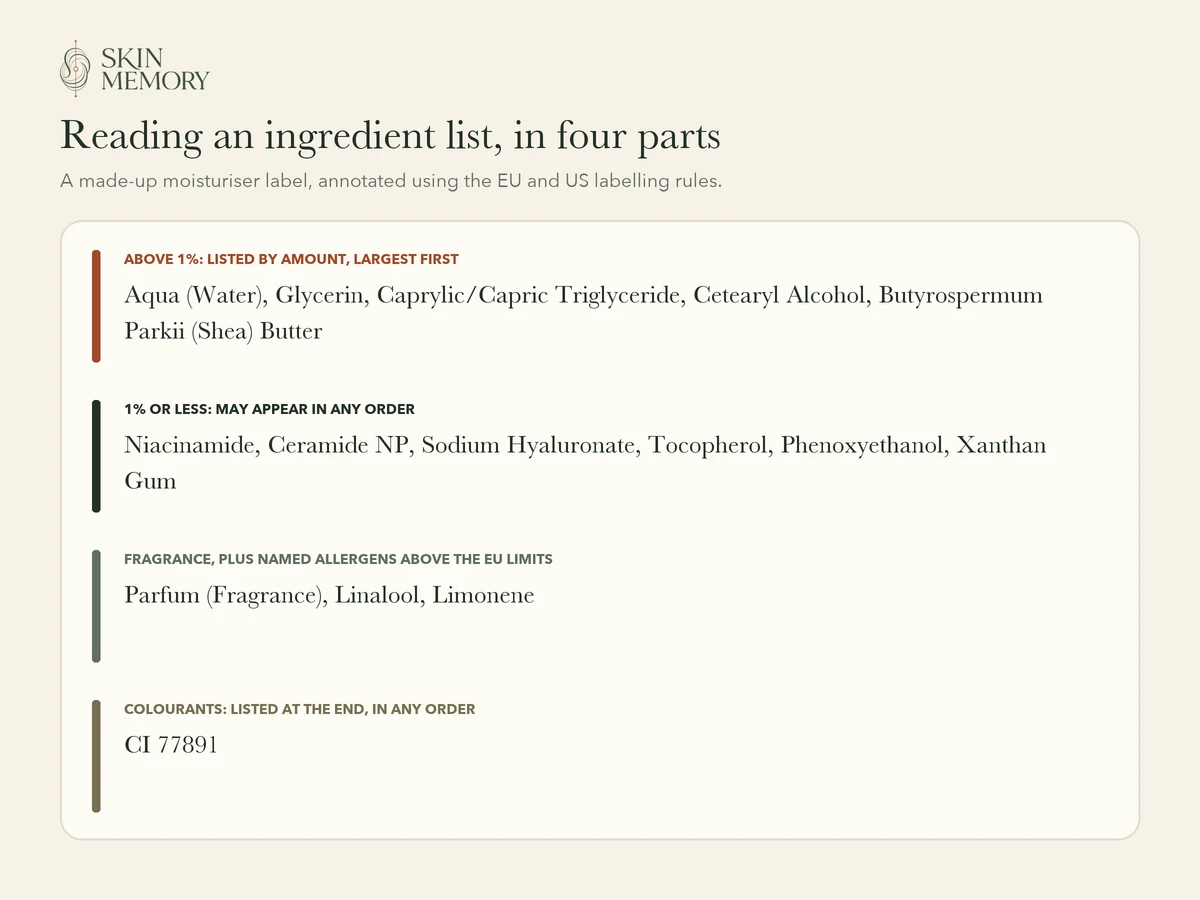
In both the EU and the US, a skincare ingredient list starts in descending order: the ingredient present in the largest amount comes first. But that ranking only applies to ingredients above 1 percent. Below that line, ingredients may be listed in any order, and colourants can go at the end in any order. Fragrance can appear as a single word, "parfum" or "fragrance", although EU law requires certain fragrance allergens to be named individually above set levels. A label tells you what is in a product and roughly how the main ingredients rank. It does not tell you exact amounts, and it cannot tell you how your skin will respond.
What the order of an ingredient list means
The rules are close to identical on both sides of the Atlantic.
In the EU, Article 19 of the Cosmetics Regulation (EC) No 1223/2009 says the list is established "in descending order of weight of the ingredients at the time they are added to the cosmetic product". Ingredients in concentrations below 1 percent may be listed in any order after those above 1 percent, and colourants (other than hair dyes) may be listed in any order after everything else.
In the US, 21 CFR 701.3 requires ingredients in "descending order of predominance", with the same structure as an option: ingredients above 1 percent in descending order, then ingredients at 1 percent or less in any order, then colour additives in any order.
The 1 percent line: where the ranking stops
The label never shows where the 1 percent line falls. You can sometimes estimate it, because some ingredients are rarely used above 1 percent, such as many preservatives and fragrance. Anything listed after them is probably below 1 percent too. But it is an estimate, not a fact the label gives you.
That has a practical consequence. An ingredient being near the end of a list does not mean it is the smallest, and two ingredients next to each other below the line could be in any proportion. If a product's front label leads with an ingredient that only appears in the second half of the list, the list tells you it is likely a small amount, not how small.
What "parfum" and "fragrance" cover
Fragrance is allowed to appear as a single word. EU law uses "parfum" or "aroma"; US rules use "fragrance" or "flavor". That one word can stand for a blend of many substances.
The EU adds one requirement on top. Certain fragrance substances known to cause allergies in some people must be named individually in the list, in addition to "parfum", when they are present above 0.001 percent in leave-on products, such as creams, or 0.01 percent in rinse-off products, such as cleansers. Linalool, limonene and citral are familiar examples. Regulation (EU) 2023/1545 expanded that list substantially. Under its transition rules, new products placed on the EU market from 31 July 2026 must use the expanded list, and products already on the market have until 31 July 2028.
The purpose is practical: people who already know they are sensitive to a specific substance can look for it by name. A named allergen on a label does not mean a product will cause a reaction for you. It means the substance is there above the limit.
Why the names look the way they do
Ingredient lists use standardised names, so that the same ingredient carries the same name across brands and countries. That is why water appears as "aqua", shea butter as "Butyrospermum Parkii Butter", and why colourants show up as codes like "CI 77891". In the EU, an ingredient in the form of a nanomaterial must be followed by "(nano)". Some US labels combine both styles, such as "Water (Aqua)".
Reading a label in five steps
- Read the first few ingredients. These are present in the largest amounts and make up most of the product. Water, glycerin and oils often lead.
- Find the likely 1 percent line. Look for a preservative or "parfum". From roughly there on, the order stops meaning much.
- Look for fragrance and named allergens if you know you react to a specific one. This is the part of the list designed for that purpose.
- Check for anything you have been told to avoid by a doctor or pharmacist, by its exact name.
- Compare against the version you used before. Formulas change. A restock with the same name and packaging can have a different list.
What an ingredient list cannot tell you
- Exact amounts. Only the ranking above 1 percent, and even that is from the time of manufacture.
- How an ingredient behaves in this formula. Concentration, pH and the rest of the formula all matter, and none of it is on the label.
- How your skin will respond. A familiar ingredient can sit in a new formula, and two products with similar lists can feel very different.
- Which ingredient is behind a reaction. Identifying a specific allergen is what formal patch testing by a clinician is for. How to describe a skin reaction to a doctor or pharmacist covers what to bring to that conversation.
Keep a copy of the list
This is the part most people skip. Once a product is used up and the bottle is in the recycling, its ingredient list is gone, and if the brand has since reformulated, the version you used may not be findable anywhere.
A photo of the back of the pack, taken when you start a product, keeps the exact list you used. It also makes the products you have already forgotten easier to identify later, and it is the version a pharmacist or dermatologist will want if you ever need to discuss a reaction.
Where Skin Memory fits
Skin Memory records what is on your shelf and when each product started, paused, was swapped or stopped. When you add a product, the app can suggest details by reading the label with your phone's camera, on the device, and you can edit anything before saving. It does not analyse ingredients or tell you whether a product suits your skin. What it keeps is the dated record: which product, which version, when.
If something changes on your skin, the reconstruction view shows what was logged in the 30 days before, in order, without naming a cause. Introducing one new product at a time keeps that window short. You can download Skin Memory for Android.
If something on your skin concerns you, talk to a doctor or pharmacist, and bring the dated record with you.
FAQ
Are skincare ingredients listed in order of amount?
Partly. In the EU and the US, ingredients above 1 percent are listed in descending order, largest first. Ingredients at 1 percent or less may be listed in any order after them, and colourants can come at the end in any order.
Do the first five ingredients matter most?
They are usually present in the largest amounts, so they make up most of the product. That says nothing about which ingredients are most active or how your skin will respond.
What does "parfum" mean on a skincare label?
It is the EU term for fragrance, and it can cover a blend of many substances. EU law also requires certain fragrance allergens to be named individually when present above 0.001 percent in leave-on products or 0.01 percent in rinse-off products.
Why are linalool and limonene on my label?
They are fragrance substances that EU rules require to be named individually above set limits, so that people who know they are sensitive to them can find them. Their presence does not mean a product will cause a reaction for you.
Can an ingredient list tell me what caused a reaction?
No. It tells you what is in a product, not how your skin responded to it. Identifying a specific allergen is what formal patch testing by a clinician is for.
Is this medical advice?
No. It is general information. If something concerns you, talk to a doctor or pharmacist.