If you only have 60 seconds
Many people use retinol and vitamin C in the same routine, and there is no good evidence that one cancels the other out. The old "never mix them" rule came from formulation chemistry: pure vitamin C (L-ascorbic acid) is unstable and works best in very acidic formulas, while retinol is usually made at a milder pH. The bigger practical concern is irritation, since both can sting or dry the skin and retinoids commonly cause redness and peeling in the first weeks. That is why a common approach is vitamin C in the morning and retinol at night. Direct research on the pairing is limited. Introduce them one at a time, and note what you use and when.
What each one is
Retinol is a form of vitamin A and one of a family of ingredients called retinoids. Others include retinal (retinaldehyde), retinyl esters such as retinyl palmitate, and prescription retinoids like tretinoin and adapalene. In a review in Clinical Interventions in Aging, Mukherjee and colleagues (2006) describe retinoids as the most studied topical ingredients for photoaged skin, and note that irritation is the main thing that limits their use. Retinol and retinaldehyde are considerably less irritating than tretinoin, but not irritation-free.
Vitamin C in skincare usually means L-ascorbic acid or one of its derivatives, such as sodium ascorbyl phosphate, magnesium ascorbyl phosphate, ascorbyl glucoside or tetrahexyldecyl ascorbate. A review by Al-Niaimi and Chiang in the Journal of Clinical and Aesthetic Dermatology (2017) notes that L-ascorbic acid is the most studied form but is unstable and hard to get into the skin, and that clinical evidence for topical vitamin C is still limited.
Where the "don't mix them" rule came from
The rule is about chemistry more than skin.
- pH. A study of L-ascorbic acid absorption by Pinnell and colleagues (2001) found it needed to be formulated below pH 3.5 to get into the skin, with absorption peaking around 20% concentration. That study was done on pig skin, so the exact numbers are a guide rather than a rule for people. Retinol products are usually formulated at a less acidic pH.
- Stability. Both ingredients break down with light and air. Vitamin C serums often darken as they oxidise, and retinol is sensitive to light.
From this, the idea spread that layering one on the other would "deactivate" both. There isn't good evidence for that on skin. Applying two products in sequence is not the same as mixing them in a jar, and skin adjusts its own surface pH fairly quickly. Some products even combine both ingredients in one formula, usually using a more stable vitamin C derivative.
What the research doesn't give us is many well-designed trials comparing people who use both together with people who use them separately. So "fine to combine" is a reasonable reading of the chemistry, not a finding from strong clinical evidence.
The real issue: irritation adds up
Both ingredients can irritate on their own:
- Retinoids commonly cause dryness, redness, flaking and stinging in the first weeks, sometimes called a "retinoid reaction." The Mukherjee review describes this as the main reason people stop.
- L-ascorbic acid at low pH can sting, especially on dry or sensitive skin or at higher strengths.
Put two potentially irritating products into the same routine and the chance of irritation goes up. Starting both at the same time also means that if your skin reacts, you can't tell which one was involved. The American Academy of Dermatology's advice on getting results from skincare products is to start one product at a time, because several new products at once can irritate skin.
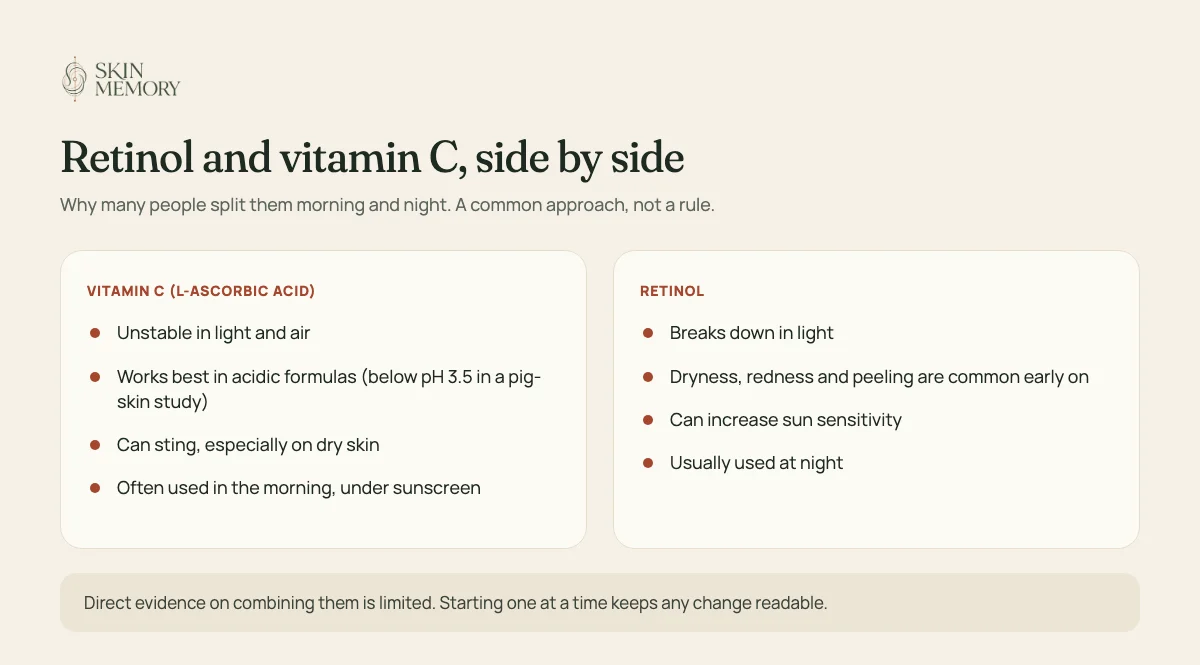
Why many people split them morning and night
Using vitamin C in the morning and retinol at night is a common pattern, and it is a practical compromise rather than a rule:
- Retinol at night because it breaks down in light, and because retinoids can make skin more sensitive to the sun.
- Vitamin C in the morning because one of its proposed roles is as an antioxidant during the day, under sunscreen.
- Separating them lowers the amount of potentially irritating ingredients on your skin at any one time.
Whatever you use, daily sunscreen matters, and particularly with a retinoid. How much sunscreen to use on your face covers the amount.
If you want to add both
This is not a prescribed routine, just a way to keep the result readable:
- Start one first. Use it for several weeks before adding the other. The AAD says most products take at least six weeks to show results.
- Patch test the new one. How to patch test skincare covers the method.
- Start a retinoid slowly. Many labels suggest a few nights a week at first. Follow the product's directions.
- Check for overlap. Some moisturisers, eye creams and serums contain retinyl esters or vitamin C derivatives too. Two products with the same active ingredient covers how to spot it.
- Note any change in how often you use each one. Moving from three nights a week to every night is a change worth dating.
If you are pregnant, trying to conceive or breastfeeding, ask a doctor or pharmacist before using any retinoid. If you use a prescription retinoid, check with your prescriber or pharmacist before adding an over-the-counter active.
What to write down
- Each product's name, its form of retinoid or vitamin C (from the ingredient list), and the strength if given
- The date you started each one
- When you use it: morning or night, and how many times a week
- Any change in frequency, dated
- What you notice, in your own words: "tight after cleansing," "flaky around the nose"
- Anything else that changed in the same weeks, such as the season or a new sunscreen
What this can't tell you
Research on ingredients can tell you what has been studied. It can't tell you how your skin will respond to a particular pair of products, or what is behind a change you notice. If your skin is persistently red, sore or peeling, or you are unsure whether what you see is expected, a pharmacist, doctor or dermatologist can help.
Where Skin Memory fits
Skin Memory keeps the details that make this easy to look back on. Add each product to your shelf with a role and a time of day, morning, night or both, and the date you started it. Changes in how often you use something are logged as their own dated changes, alongside added, dropped, paused and swapped. You can photograph the ingredient list to keep it to hand; the text is read on your phone, and you check it before saving.
If you notice something, record it as an observation in your own words. Looking back from that date, the reconstruction view shows what was on your shelf and what changed in the 30 days before, without naming a cause. You can download Skin Memory for Android.
More on reading labels: how to read a skincare ingredient list and what does non-comedogenic mean.
If something on your skin concerns you, talk to a doctor or pharmacist, and bring the dated record with you.
FAQ
Can you use retinol and vitamin C together?
Many people do, and there is no good evidence that one cancels the other. The main practical concern is irritation, since both can dry or sting the skin. Direct clinical research on the combination is limited.
Should I use vitamin C in the morning and retinol at night?
It is a common approach. Retinol breaks down in light and can increase sun sensitivity, so it is usually used at night. Vitamin C is often used in the morning under sunscreen. Splitting them also reduces how much potentially irritating product is on your skin at once.
Does vitamin C deactivate retinol?
There isn't good evidence that it does on skin. The idea comes from formulation chemistry: L-ascorbic acid works best at a low pH, and retinol is usually formulated at a milder one. Applying them in sequence is not the same as mixing them in a jar.
Can I start retinol and vitamin C at the same time?
You can, but if your skin reacts you won't know which one was involved, and starting several new products at once can irritate skin. Starting one, then adding the other several weeks later, keeps things readable.
Is retinol the same as retinoids?
Retinol is one type of retinoid. Retinoids also include retinal, retinyl esters and prescription products such as tretinoin and adapalene. They differ in strength and how irritating they tend to be.
Can I use retinol while pregnant?
Ask a doctor or pharmacist before using any retinoid if you are pregnant, trying to conceive or breastfeeding.
Is this medical advice?
No. It is general information. If something concerns you, talk to a doctor or pharmacist.