
If you only have 60 seconds
This is a free, four-page printable skincare log you can download as a PDF, in **[A4](/downloads/skin-memory-skincare-log-a4.pdf)** or **[US Letter](/downloads/skin-memory-skincare-log-letter.pdf)**, with no email or sign-up. It has a page for your starting point, a shelf list of every product with start and stop dates, a change log with one line per change, and daily notes for what you notice and where. It is built around one idea: a dated record is easier to look back on, and easier to show a pharmacist or dermatologist, than memory. It has no scores or ratings, and it won't tell you what caused anything. Print it, fill in what you can, and leave gaps without guilt.
Download the printable skincare log
Both are free to print and copy for your own use. Print as many change log and daily notes pages as you need; the first two pages usually last much longer.
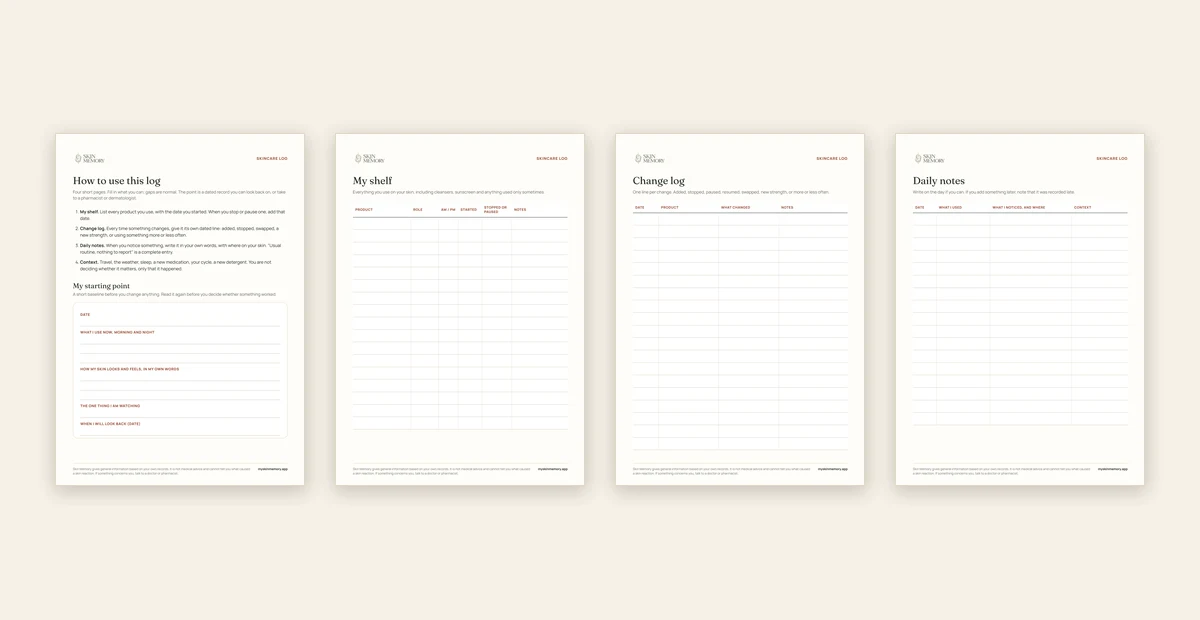
What's on each page
Page 1: How to use this log, and your starting point
A short guide, then a starting point box: the date, what you use now morning and night, how your skin looks and feels in your own words, the one thing you are watching, and the date you will look back.
That last line matters more than it looks. The American Academy of Dermatology says most skincare products take at least six weeks to work, and some take three months. Writing a review date down before you start stops you judging too early. Why it's hard to tell if a skincare product is working explains why the baseline is the part people most often skip, and most often wish they had.
Page 2: My shelf
One row per product: name, role (cleanser, serum, moisturiser, sunscreen and so on), morning or night, the date you started, the date you stopped or paused it, and notes. Include the easy-to-forget ones: cleansers, sunscreen, a mask you use once a week, the body lotion that ends up on your neck.
This page answers the question people struggle with most later: what was I using then? It is also where you can spot two products doing the same job; two products with the same active ingredient covers what to look for.
Page 3: Change log
One line per change, with the date: added, stopped, paused, resumed, swapped, new strength, or used more or less often. Changes are the entries you will look for most, so they get their own page rather than being buried in daily notes.
If you only keep one page going, keep this one. A change log with nothing else in it is still useful months later.
Page 4: Daily notes
Date, what you used, what you noticed and where, and context. Write what you see in plain words: "tight across the cheeks after cleansing," "two small bumps on the chin." Location is easy to forget and hard to reconstruct. "Usual routine, nothing to report" is a complete entry.
The context column is for things you can't control but might want to know about later: travel, cold weather and heating, short nights, a new medication, your cycle, a new laundry detergent. You are not deciding whether any of it matters, only noting that it happened. Why your skin changes in winter and when you travel have lists of the kinds of things worth a line.
How to use the log well
- Fill in your starting point and shelf on day one. It takes about ten minutes, and you only do it once.
- Add one change at a time where you can. If several things change at once, any difference afterwards belongs to all of them together. How to introduce a new product one change at a time covers the method.
- Write on the day. If you fill something in later, write "recorded late" next to it. Notes backfilled from memory are less reliable, and it helps to know which ones they are.
- Patch test new products and log it. The AAD's method for testing skin care products is a small spot, twice a day, for seven to ten days. Record it in the change log; how to patch test skincare has the details.
- Keep a photo of each ingredient list. Paper can't hold the label, but you can tape a printed photo to the back, or keep the photos in a phone album named for the log.
- Read your starting point before you look in the mirror on your review date. Compare notes, not memories.
What not to write
The log deliberately has no columns for scores, severity, or "cause." A 7 out of 10 means little a month later, and guessing a cause in the moment tends to stick even when it is wrong. Describe what you see; leave interpretation for later, ideally with a pharmacist or dermatologist.
What this can't tell you
A log is a record. It can show what changed and when, but it can't tell you why your skin changed or whether a product is right for you. If something on your skin concerns you, or a reaction spreads, blisters or comes with swelling, talk to a doctor or pharmacist, and get urgent help for swelling of the face, lips or eyes or difficulty breathing. Bring the log with you; how to describe a skin reaction to a doctor or pharmacist covers what helps.
Where Skin Memory fits
The printable log follows the same structure as the Skin Memory app: a shelf of products with dates, a log of changes, and observations in your own words. Paper is a perfectly good way to keep it. The app adds what paper can't do: for any date, the reconstruction view shows what was on your shelf and what changed in the 30 days before, and says when three or more changes overlap, without naming a cause. You can mark entries as recorded late, photograph labels so the app reads the name and ingredients on your phone, and export a readable timeline to share.
It is Android only for now, and works without an account. If you'd like to try it, you can download Skin Memory for Android. If you'd rather stay on paper, the log above is yours to keep.
More on keeping a record: how to keep a skincare journal, how to track your skincare routine and what to look for in a skincare tracker app.
If something on your skin concerns you, talk to a doctor or pharmacist, and bring the dated record with you.
FAQ
Is the printable skincare log free?
Yes. It is a free PDF in A4 and US Letter, with no email or sign-up needed. You can print and copy it for your own use.
What should a skincare log include?
The date, the products you use, every change (added, stopped, swapped, more or less often), what you notice in your own words and where on your skin, and context such as travel, weather, sleep or a new medication.
How often should I fill in a skincare log?
Whenever something changes or you notice something. Daily entries are optional; "usual routine, nothing to report" is a complete entry, and gaps are normal.
Is a paper skincare journal better than an app?
Neither is better for everyone. Paper is private, flexible and needs no phone. An app is better at looking back to a specific date and spotting overlapping changes. The best one is the one you keep using.
Why doesn't the log have a rating scale?
Scores are hard to compare over weeks and don't say what you actually saw. A short description, with where on your skin, is more useful to you and to a pharmacist or dermatologist later.
Can I bring the log to a dermatologist appointment?
Yes. A dated list of products and changes is one of the most useful things to bring. Take the shelf and change log pages at least.
Is this medical advice?
No. It is general information. If something concerns you, talk to a doctor or pharmacist.