If you only have 60 seconds
The SPF number on a sunscreen is measured in a lab at about 2 milligrams of sunscreen per square centimetre of skin, and most people apply less than that, so they get less protection than the label suggests. For the face, the American Academy of Dermatology suggests at least a teaspoon, which it compares to the length of your index and middle fingers, while the Skin Cancer Foundation describes about a nickel-sized dollop for the face alone. The guides differ because faces and products differ, but they point the same way: more than a thin smear, applied before going outside, and reapplied every two hours outdoors. Using the same measure every day also keeps your routine consistent, which matters if you are keeping a record.
Why the amount matters: the 2 mg/cm² test standard
When a sunscreen is tested for its SPF, it is applied at a fixed thickness: about 2 milligrams per square centimetre of skin. The Skin Cancer Foundation notes that the SPF on the label assumes that amount.
In everyday life, people tend to apply much less, especially on the face, where a thick layer can feel heavy or pill under makeup. Using less than the test amount means the protection you get is lower than the number on the bottle. That is why dermatology bodies focus on the amount, not just the SPF.
How much sunscreen to use on your face
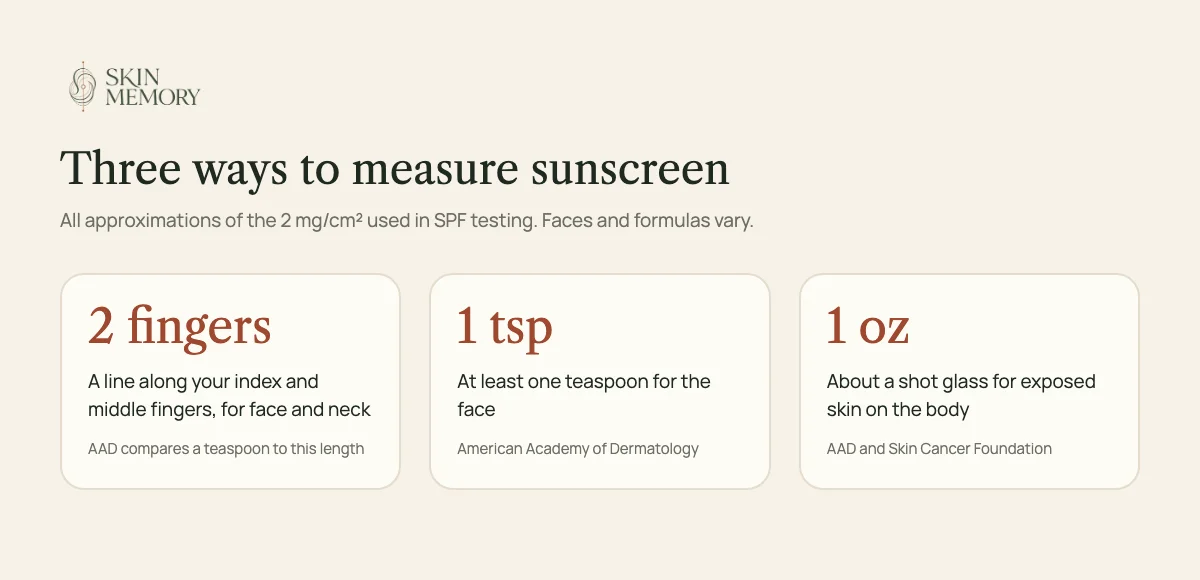
The guides you will see are different ways of approximating the same standard:
- At least one teaspoon, according to the American Academy of Dermatology's guidance on how to apply sunscreen. The AAD compares this to the length of your index and middle fingers, which is where the popular "two-finger rule" comes from.
- About a nickel-sized dollop for the face alone, as described by a dermatologist in the Skin Cancer Foundation's guidance.
- About one ounce, roughly a shot glass, for exposed skin on the body, according to both organisations. Larger bodies may need more.
The two face measures don't match exactly, and that is honest: faces vary in size, some guides include the neck and ears and some don't, and creams, lotions and gels have different densities. The practical point is the same. Use enough to cover the face, neck and ears evenly, which for most adults is noticeably more than a thin smear.
When to apply and reapply
The AAD's guidance:
- Choose broad-spectrum, water-resistant sunscreen with SPF 30 or higher. The Skin Cancer Foundation suggests SPF 30 at minimum, and 50 or higher for extended time outdoors.
- Apply about 15 minutes before going outside, so it has time to settle.
- Reapply every two hours when outdoors, and straight away after swimming or sweating.
- Don't miss the edges. Ears, neck, hairline and the tops of the feet are commonly missed. Use a lip balm with SPF 30 or higher.
With sprays, the AAD suggests spraying until skin glistens, then rubbing it in, and never spraying directly onto the face: spray into your hands first.
Where sunscreen sits in a routine
In the morning, sunscreen goes after moisturiser and before makeup. What order to apply skincare covers the full sequence. If your moisturiser contains SPF, the same amount question applies to it: a thin layer of moisturiser is unlikely to reach the test amount.
Sunscreen can also go off. Check the period after opening symbol and the expiry date, especially on a bottle that has been in a hot car or a beach bag. Winter is not a reason to stop: the AAD's dry skin tips, covered in why your skin changes in winter, still include sunscreen on exposed skin. And on a trip, decanting into a tiny bottle often means using less without noticing.
Why the amount is worth noting
A change in how much of a product you use is a change, even if the product is the same. Switching from a thin layer to two full finger-lengths, or to a new texture you apply differently, changes what is on your skin every day.
So when you start a new sunscreen, or change how much you use:
- Note the date and the product, with a photo of the label.
- Note the amount in a way you can repeat: "two fingers, face and neck".
- Note what you notice, in your own words. New sunscreens can feel different, and some people find certain formulas sting near the eyes.
- Patch test a new formula first, especially if you have had trouble with sunscreens before.
Where Skin Memory fits
Skin Memory keeps the dated record of your routine, morning and evening. Your shelf holds each sunscreen with the date it started, and the change log records swaps and changes in how you use something. Notes about amount or texture go in the daily journal, and Note a response records an observation like stinging or dryness in your own words, without the app deciding what it means.
If something changes, the reconstruction view shows what was logged in the 30 days before, in order, without naming a cause. You can download Skin Memory for Android.
If something on your skin concerns you, talk to a doctor or pharmacist, and bring the dated record with you.
FAQ
How much sunscreen should I use on my face?
The American Academy of Dermatology suggests at least a teaspoon for the face, about the length of your index and middle fingers. The Skin Cancer Foundation describes about a nickel-sized dollop for the face alone. Both are ways to approach the amount used in SPF testing.
What is the two-finger rule for sunscreen?
It means squeezing a line of sunscreen along the length of your index and middle fingers and using that for your face and neck. The AAD uses the same comparison to describe a teaspoon.
What does 2 mg/cm² mean for sunscreen?
It is the thickness sunscreen is applied at in lab SPF testing: 2 milligrams per square centimetre of skin. The SPF on the label assumes that amount, and most people apply less.
How often should I reapply sunscreen?
The AAD suggests reapplying every two hours when outdoors, and straight away after swimming or sweating.
Is SPF in moisturiser or makeup enough?
Only if you apply enough of it to reach the tested amount, which is more than most people use of a moisturiser or foundation. Many people use a separate sunscreen for that reason.
Do I need sunscreen in winter or on cloudy days?
The AAD advises sunscreen on exposed skin year-round, including on cloudy days.
Is this medical advice?
No. It is general information. If something concerns you, talk to a doctor or pharmacist.