If you only have 60 seconds
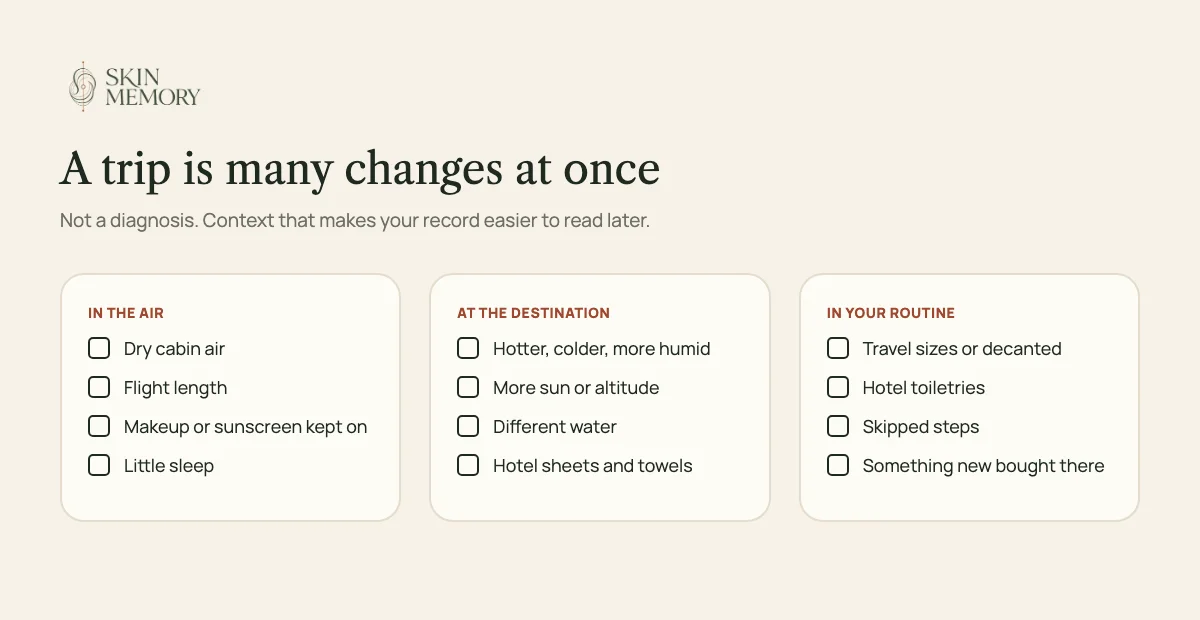
Travel changes several things your skin is exposed to at once. Aircraft cabin air is dry: a NIOSH study of 33 commercial flights measured average humidity as low as about 10 percent, lowest on long flights, and research links low humidity with reduced skin barrier function. At your destination, the climate, sun, water and even the pillowcase are different. And routines change too, with decanted products, hotel toiletries, skipped steps and different sleep. If your skin changes on a trip, any of these could be involved, which is exactly why a few dated notes help more than a guess.
What flying does to the air around your skin
Cabin air at cruising altitude starts out extremely dry. Outside air is very cold and holds little water, and warming it up for the cabin doesn't add any.
A study of 33 commercial flights by the US National Institute for Occupational Safety and Health, published through the CDC, measured relative humidity throughout each flight. Average humidity across a flight ranged from about 10 to 46 percent, and 5-minute readings dropped as low as about 5 percent. Humidity was lowest on long flights, on wide-bodied aircraft, and on aircraft at higher altitudes. For comparison, indoor air at home is often 30 to 50 percent.
What low humidity does to skin has been studied on the ground. A 2016 review by Engebretsen and colleagues concluded that low humidity and low temperatures reduce skin barrier function and make skin more reactive to irritants. That is the same mechanism behind why skin often changes in winter, compressed into a few hours.
For most people, the effect of a single flight is temporary tightness or dryness. Long-haul flights are where it is most noticeable.
What changes when you arrive
A flight is only the start. A trip can change, all at the same time:
- Climate. Hotter and more humid, colder and drier, or higher altitude.
- Sun exposure. More time outdoors, a different UV index, more time near water or snow.
- Water. A different mineral content, and sometimes more chlorine in pools. Hard water can leave more cleanser residue on skin.
- Products. Decanted into travel bottles, swapped for travel sizes, borrowed, or replaced by hotel soap and shampoo.
- Laundry and fabrics. Hotel sheets and towels washed in detergents you don't use at home.
- Sleep, food, alcohol and stress. Jet lag and a different daily rhythm.
Routine changes are the easiest to forget
Of all of these, the routine changes are the ones you control, and the ones most often forgotten afterwards. A few that come up again and again:
- Decanted products. A moisturiser decanted into a small pot is the same product, but a sunscreen decanted from a large bottle into a tiny one often means using less of it.
- Older products. The travel bag often holds the half-used tube from last year's trip. Check the period after opening symbol before you pack it.
- New products bought on the trip. A local sunscreen or a duty-free serum is a new product, and starting it mid-trip adds one more change to an already busy week.
- Skipped steps. Late nights and early flights mean cleansing and moisturising often happen less, or not at all.
If you want to try something new, it is easier to read the result if you start it at home, before or after the trip. Introducing one product at a time explains why, and patch testing it first is easier when you aren't living out of a suitcase.
General tips for skin on a flight
These are common-sense steps that follow from the dry-air research, not a treatment plan:
- Moisturise before you fly, and pack a small moisturiser and lip balm in your hand luggage, within liquid limits.
- On long flights, some people find a simple, fragrance-free moisturiser partway through helps with tightness.
- Keep wearing sunscreen at your destination, and remember that a window seat on a long day flight is still exposed to daylight.
- Pack the products you already use, rather than relying on unfamiliar hotel toiletries.
If skin changes on a trip are painful, spread, or don't settle once you're home, talk to a pharmacist or doctor.
What to note on a trip
A short note each day is plenty:
- Travel days, with dates and flight length. "Long-haul, 11 hours" is enough.
- Where you are, and anything notable about the climate.
- Any product swaps, including hotel products and anything new you bought.
- What you notice, where, and in your own words.
- The day you got home, and when your normal routine resumed.
That record means the next trip starts with something to compare against, and after a few trips, you may notice your own pattern without relying on memory.
Where Skin Memory fits
Skin Memory keeps a dated record without telling you what it means. The change log records product swaps, pauses and new additions, so the hotel cleanser and the duty-free serum are on the record with dates. The daily journal holds trip context in your own words, and Note a response records an observation like dryness or breakouts without the app interpreting it.
Back home, your skin timeline shows the trip alongside everything around it. If something changes, the reconstruction view shows what was logged in the 30 days before, in order, without naming a cause. Because the record is on your phone, it travels with you. You can download Skin Memory for Android.
If something on your skin concerns you, talk to a doctor or pharmacist, and bring the dated record with you.
FAQ
Why does my skin change when I travel?
A trip changes many things at once: dry cabin air on the flight, a different climate, sun and water at your destination, and changes to your routine and sleep. Any of these could be involved.
Does flying dry out your skin?
Cabin air is dry. A NIOSH study of 33 flights measured average humidity as low as about 10 percent, lowest on long flights, and research links low humidity with reduced skin barrier function.
How humid is the air on a plane?
In the NIOSH study, average humidity per flight ranged from about 10 to 46 percent, with short readings as low as about 5 percent. Indoor air at home is often 30 to 50 percent.
Why do I break out after travelling?
There is rarely one answer. Climate, sun, water, products, sleep and stress can all change during a trip. Dated notes help you and a clinician see what changed, without naming a cause.
Should I start new skincare on holiday?
It is usually easier to read the result if you start new products at home, one at a time, rather than during a trip when everything else is changing too.
Is this medical advice?
No. It is general information. If something concerns you, talk to a doctor or pharmacist.