If you only have 60 seconds
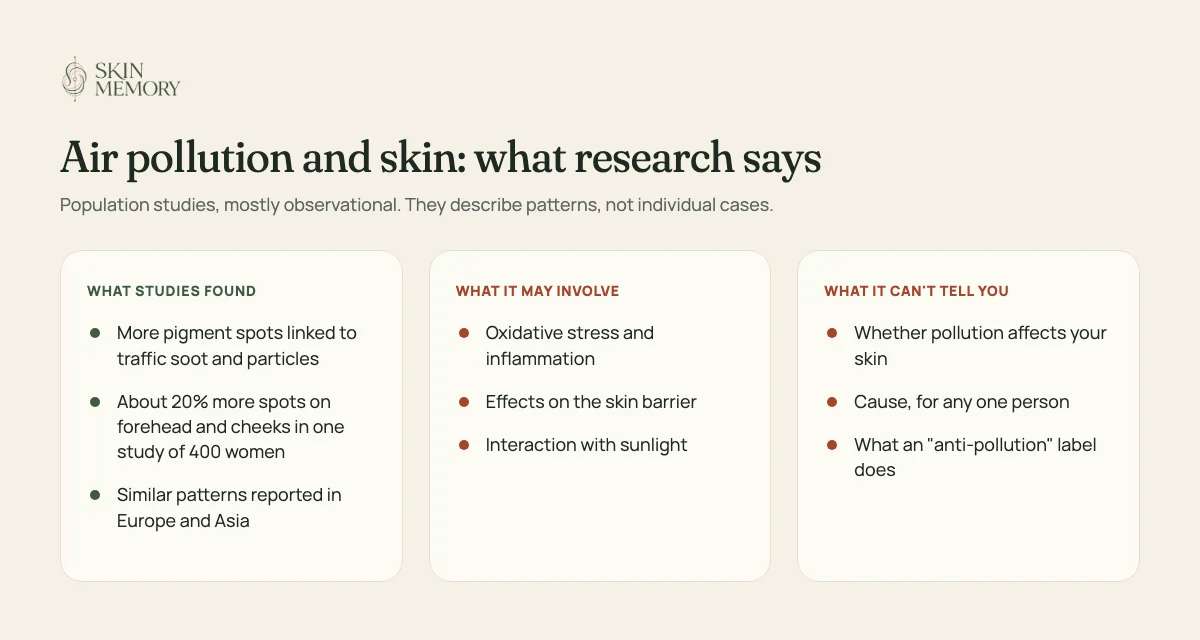
Research links outdoor air pollution with changes in skin across large groups of people, most consistently more pigment spots and other signs of skin ageing. A study of 400 women in Germany by Vierkötter and colleagues found that higher exposure to traffic-related soot and particles was associated with about 20% more pigment spots on the forehead and cheeks. These are associations in populations, not proof of what affects any one person's skin, and the research is still growing. "Anti-pollution" on a skincare label has no agreed definition. If you live or work somewhere with poor air, it is useful context to note alongside your routine.
How much pollution are we talking about?
Air pollution is close to universal. The World Health Organization's fact sheet on outdoor air quality reports that almost the entire global population lives in places where air quality exceeds its guideline levels. The main pollutants studied for skin are:
- Particulate matter (PM10 and PM2.5): tiny particles from traffic, industry, heating, and burning wood or crops
- Nitrogen dioxide (NO2): mostly from road traffic
- Ozone: formed at ground level when sunlight reacts with other pollutants
- Polycyclic aromatic hydrocarbons: carried on soot particles
Skin is one of the main surfaces exposed to all of these, alongside the lungs.
What the research has found
Pigment spots and skin ageing
The best-known study is by Vierkötter and colleagues in the Journal of Investigative Dermatology (2010). They assessed signs of skin ageing in 400 women aged 70 to 80 in Germany and compared them with estimated exposure to traffic-related pollution where they lived. Higher exposure to soot and particles was associated with more pigment spots, and less strongly with more pronounced wrinkles. An increase in soot from traffic was associated with about 20% more pigment spots on the forehead and cheeks.
A review by Schikowski and Hüls in Current Environmental Health Reports (2020) brought together studies from Europe and Asia. It describes the link between traffic-related pollution and signs of skin ageing, especially pigment spots, as consistent across several populations, with associations reported for particulate matter, nitrogen dioxide and soot.
How it might happen
Laboratory and mechanistic studies suggest several possible routes, including oxidative stress, inflammation, and effects on the skin barrier. Pollutants may also interact with sunlight. These mechanisms are still being worked out, and much of the evidence comes from cell and animal studies rather than people.
Where the research stops
It is worth being clear about what these studies can and can't show:
- They are mostly observational. They compare groups with different exposure. People who live near busy roads may also differ in sun exposure, smoking, income, diet and other factors, and studies try to adjust for these but can't remove them completely.
- Exposure is estimated. Most studies estimate pollution where people live, not what each person's skin actually encountered.
- Many study groups are narrow. The Vierkötter study looked at older white women in one country. Results in other ages, skin types and places are less certain, though studies in Asia have reported similar patterns.
- They describe populations, not individuals. An association across 400 people doesn't tell you whether pollution is involved in anything you see on your own skin.
What "anti-pollution" skincare means
"Anti-pollution" has appeared on many products in recent years. There is no legal definition or standard test for the phrase in the US, UK or EU. Brands use it for products with antioxidants, film-forming ingredients, or cleansers marketed for city skin. In the EU and UK, a brand must be able to support any claim it makes, but nothing defines what "anti-pollution" has to achieve.
That doesn't mean such products do nothing; it means the label alone can't tell you what they do. The ingredient list tells you more, and how to read a skincare ingredient list covers how. Daily sunscreen is the step with the clearest evidence for skin ageing in general, and the AAD's guidance on how much sunscreen to use applies whether you live in a city or not.
What to write down
Pollution is something most people can't control day to day, but it can be useful context in a record:
- Where you spend your days. Moving to a city, a new commute along a busy road, or working outdoors are all worth a dated note.
- Unusual air days. Smoke from wildfires or crop burning, smog episodes, or long stretches of poor air quality. Many weather apps show an air quality index.
- Travel. A trip somewhere with very different air is a change, like a change in climate; see why your skin changes when you travel.
- Your routine at the same time. If you add an "anti-pollution" product or change your cleanser, give it its own dated line.
- What you notice, in your own words. Where on your skin, and when.
None of this is about deciding pollution is behind a change. It is about having the context written down if you ever want to look back, or show a pharmacist or dermatologist.
What this can't tell you
Research on air pollution can describe patterns across populations. It can't tell you what is behind a change on your own skin, and neither can an app or a blog post. If something on your skin concerns you, or changes in a way that worries you, talk to a doctor or pharmacist. Changes in moles or new spots that look different from the rest should always be checked by a doctor.
Where Skin Memory fits
Skin Memory is a place to keep that context next to your routine, without drawing conclusions. Products on your shelf carry the dates you started, paused or dropped them, and changes are logged as they happen. Anything you notice goes in as an observation, and a journal note is a natural place for context like a move, a smoky week or a trip.
When you look back from a date, the reconstruction view shows what was on your shelf and what changed in the 30 days before, and says when three or more changes overlap. It doesn't decide whether pollution, a product or anything else was involved. You can download Skin Memory for Android.
More on life and environment: why your skin changes in winter, does hard water affect your skin and does your menstrual cycle affect your skin.
If something on your skin concerns you, talk to a doctor or pharmacist, and bring the dated record with you.
FAQ
Does air pollution affect your skin?
Research links outdoor air pollution with signs of skin ageing across large groups of people, most consistently more pigment spots. These are population-level associations from mostly observational studies, so they can't show what affects any one person's skin.
What did the main study on pollution and skin find?
A 2010 study of 400 women aged 70 to 80 in Germany found that higher exposure to traffic-related soot and particles was associated with more pigment spots and, less strongly, more pronounced wrinkles. An increase in traffic soot was associated with about 20% more pigment spots on the forehead and cheeks.
Which pollutants are studied for skin?
Mainly particulate matter (PM10 and PM2.5), nitrogen dioxide, ground-level ozone, and polycyclic aromatic hydrocarbons carried on soot.
Does anti-pollution skincare work?
"Anti-pollution" has no legal definition or standard test, so the label alone doesn't tell you what a product does. The ingredient list tells you more. Daily sunscreen has the clearest evidence for skin ageing in general.
Should I change my skincare if I live in a city?
That is a personal choice, and a pharmacist or dermatologist can help with specific questions. If you do change something, change one thing at a time and note the date, so you can look back at what happened afterwards.
Is indoor air pollution a concern for skin?
Research has focused mainly on outdoor air. Indoor sources like cooking smoke and heating can also produce particles, but there is much less research on their effects on skin.
Is this medical advice?
No. It is general information. If something concerns you, talk to a doctor or pharmacist.